Body Health, Essay, Mental Health

HANG LIKE CHICKEN

In my first-ever gym class of high school, we underwent a fitness diagnostic. Our gym teacher required the students to perform as many chin-ups as they could. If they were not able to do a chin-up, he offered, they could simply hang from the bars.

The oddness of those two choices – to either perform an act or engage in something that arguably proves nothing except the presence of fingers – was further underscored by the vast breadth of physical prowess. If you had hit puberty by then, you could do chin-ups. If you hadn’t, you hung like a limp flag or, more realistically, the trussed and plucked chicken hanging in a meat shop. Since I’m barely hitting puberty at 22, it’s an easy guess to figure out which camp I fell into.

That did not stop me from pathetically attempting a chin-up. I didn’t realize that it’s nearly impossible to do a chin-up from fully-extended arms, so I tucked my knees underneath me and tried to pull myself up from ramrod-straight arms. After several tense, physically agonizing moments, I let myself hang quietly before dropping back down to the floor.

And I remember, in the seconds that I hung from the bar, thinking how completely pointless this exercise was. Gym class proceeded much in the same way; after freshman year, I just opted to do homework with a clutter of the other unathletic boys while the fitter ones fucked around with dodgeball, or whatever. By senior year, I was skipping out of gym entirely – using my senior privilege and status a runner to avoid it. But, to be honest, having a gym class once every six days wasn’t doing me, or anyone, any favors.

So for most of my life, the chin-up, and any desire to do it, eluded me. When I started working out in college, I hopped in and out of the chin-up phase. Once I realized that clinging to the bars and literally leaping up into a chin-up position didn’t technically count, I swapped to the assisted pull-up machine and avoided it whenever I could.

The assisted pull-up machine requires you to put your knees on a pad and subtract weight from your total mass. So if you’re 160 pounds, and you subtracted fifty pounds, you were doing the chin-ups with a body weight of 110 pounds. I was subtracting so much weight that I was actually flinging myself upwards with every pull and reaching an exosphere orbit.

I would eye the people who could do a pull-up or chin-up unassisted with hot glowering envy. It seemed literally impossible, and then I saw people actually adding weights to their own self and doing repetitions with that. That was as unbelievable to me as those stories of mothers lifting up cars to save their loved ones – actually more unbelievable. I began to measure my prowess in terms of how many unassisted repetitions I could do – one was bad, two was better, three was ideal.

But as I worked out more, I began to reacquaint myself with the pull-up machine. As I lost weight and gained muscle, the notches of the weight began to shift lighter and lighter. Eventually, I was doing ten to twenty pounds of assistance, for a weight of roughly 185.

And then, a few weeks ago, I decided to leave the pad entirely. Straining, I pulled myself up – my elbows narrowing into neat acute angles – and down. When I completed sixteen chin-ups, four repetitions in four sets, I fell into a crouch and felt my heart pump blood headily into the aching muscles. But I kept doing it. every day, at the beginning of my workout, I did sixteen chin-ups – always in four sets of four – before moving onto the rest of my workout. I found that the less I focused on what I was about to do, the better I performed. If I hesitated, arms extended upward but feet still on the ground, I could barely get myself into the air.

I began to change it up – I added another set of pull-ups to the routine. Eventually, I switched to sixteen pull-ups (working the back muscles, shoulder muscles and the latissimus dorsi muscles). I tacked on a set of chin-ups, and on arms days, I would do sixteen of each.

I’ve noticed more muscle changes in the few weeks that I’ve started doing unassisted pull-ups. My shoulders are squarer, my collarbones swoop with the graceful lean of ship’s bows, and my biceps are bigger. In the shower, I catch glimpses of back muscles rippling in ways that they didn’t before. I’m obsessed with my shoulder blades, their hookedness like two eagle beaks.

Unfortunately, like a lot of people, I have a complex relationship with my body. And I’ve often leaned on the gym in unhealthy ways, eviscerating myself on days when I had to skip, or punishing myself for days that I didn’t push myself as far as I could’ve. In my most depressed, the gym becomes more of an outlet and a crutch. Before, when I looked my best, it’s often because I was feeling my worst. At a particular low point in college, mental health-wise, I would escape to the gym for hours every day, later pinching the fat on my hips as it melted away. I obsess over my body’s aesthetic, how this looks and how this lays.

I’ve always carried that anxiety when going to the gym; that I could backslide and become obsessive again. I still have lingering habits, a twinge of despair when I weigh myself, or a slight internal battle about how much cardio to do. I take my backslides softly, and slowly, and I’m trying to treat myself gently. It doesn’t always work, maybe not even half of the time, but I try.

Doing these pull-ups aren’t about how they will make my body look. It is a physical challenge, a test of my own strength – something that doesn’t come from aesthetics alone.

But this feels different for me.

When I’m doing pull-ups, I revel in the strength as I lift upwards. I imagine all of the scenarios where I can pull myself up. Action movie scenes, where the ground falls away beneath me and I have to swing myself up from the lip of a cliff. Deep dark holes that I’m trapped in. American Ninja Warrior monkey bars. I revel in getting stronger, and it feels wholly unconnected to aesthetics or attractiveness. In every muscle micro-tear, I steel myself with strength. I feel myself getting stronger, and I nourish it like a seedling. I picture myself as a warrior, each line of muscle meaning that I am more capable, more sturdy, more indomitable.

It isn’t about how I look – it’s about how I feel.

And damn, sis, I feel good.

Standard
Essay, feminism, Thinkpiece

CITIZEN ROSE – SUSPENDING DISBELIEF

While watching the first installment in a series of five, I remembered how primed we are to not believe women.


 I went into the first episode interested, but hesitant. I didn’t really know much about it, just that it was on E!. The only similar project that E! has done recently was I Am Cait, which skewed more documentary and less reality than any previous programming. Citizen Rose is a documentary, but it often elevates to an art piece. It’s non-linear at times, and broken up by short vignettes and multiple perspectives and angles.

I decided to watch it after watching the short clip, that’s since gone viral, of Rose getting into a verbal altercation with a trans woman at a book signing for Brave, McGowan’s new book. McGowan said that the trans activist had been a plant utilized to disrupt her, and she promptly canceled the tour. One of my favorite podcasts, Babe?, discussed both the incident and the documentary – I love their opinions, so I felt curious enough to watch it. The first installment is uploaded in full onto YouTube.

I want to preface this by saying that I am white, I am cisgender, and I am male. My privilege informs how I see the world, and while I try to educate myself and be mindful, I still have that lens built into my experience. If I say anything that’s uneducated, or misinformed, or wrong, I would love to be educated.

I think the biggest thing I took away from Citizen Rose was how deeply the instinct to not believe women is built into me.

I noticed it when Rose said that she was targeted by spies and was worried about being killed; I had this gut reaction to call her a liar, or crazy, or delusional. But then I realized that she had already been proven right.

In Ronan Farrow’s article, he described the lengths Harvey Weinstein went to discredit Rose. He used two different black ops spy units, one called Black Cube, to infiltrate Rose’s life – find out things that could be used against her, steal her then-unpublished book from her. This is, according to Farrow, proven. I had forgotten this actively, so when Rose said that the trans woman at her book signing was a plant used to attack her, I immediately dismissed her.

But I was more willing to believe a man that was fact-checking than the woman herself. I had this knee-jerk reaction to distrust Rose.

If Rose was right about the spies following her, then she might be right about the plant. The problem is that we don’t know, but we refuse to offer her the benefit of the doubt. And even if it’s not true, McGowan has existed in a world of constant gaslighting for the last twenty years. She was never believed, or heard, or acknowledged. She didn’t know who to trust. For twenty years, she must’ve felt like she was losing her mind.

This is part of the problem. We refuse to believe women. And I don’t think that this is an accident.

I thought back to the recently released Quentin Tarantino audio about Roman Polanski.

“He had sex with a minor,” Tarantino said in the recording. “That’s not rape. To me, when you use the word rape, you’re talking about violent, throwing them down – it’s like one of the most violent crimes in the world.” Though Tarantino later said that he was playing “devil’s advocate” in that interview, what does that say about how he views rape? And how does that translate into his work?

In one of her speeches, Rose talks about the cult of Hollywood that dictates how we perceive people.

“This is what you are as a woman…this is what you are as a man,” she says. “This is what you are as a boy, girl, gay, straight, transgender.” Then she leaned into the microphone, “But it’s all told through 96 percent males in the Director’s Guild of America; that statistic has not changed since 1946.”

Hollywood is often dismissed as shallow, vapid and fluffy. But perhaps that’s on purpose. Because if you don’t see it as substantial, then you don’t see it as a threat. Then you suck down the poison they give you without even thinking, without even realizing how it informs how you perceive the world. Representation matters not just for its own sake. It affects every part of you, how you see other people and how you see yourself. So if movies tell you that women are objects to be pursued, and that men must be dominant in their pursuits, you are being trained to not recognize rape and assault. You learn it through the rigid definition of what predators tell you it is.

But that’s not the truth, and that’s what Rose is trying to say. The things we’ve been given, the tools and the vocabulary, are built on an altar of maintaining the status quo. It’s meant to keep women quiet, docile and objects; it’s meant to keep men aggressive and unemotional and straight.

“Don’t rock the boat.” “Don’t be dramatic.” “Don’t worry.” “Don’t be a bitch.” “Don’t exaggerate.” “Don’t be crazy.”

At one point, Rose asks the viewer to recall everything they know about her. That’s she slutty; that she’s crazy; that she’s unwell. And she asks them, us, to think about who is telling that to us.

In many cases, it was people under the thumb of Harvey Weinstein. People like Weinstein used the cult of Hollywood to introduce and reinforce stereotypes and misinformation about women, queer people, people of color. And that immediately cripples any point to the contrary, because you will never, ever be believed.

Rose McGowan is not perfect; far from it. She’s messy and complex and complicated and says the wrong things sometimes. But that’s everybody; we are all imperfect. But think about why we insist that our leaders be completely without flaws – is it because we need to be led by perfect people, or is it meant to stop us from rallying behind someone? Is it meant to keep us rapid and frothing at each other, rather than at the people who deserve it?

It’s why we attack the actors, usually female, who star in Woody Allen’s movies but still give Woody Allen money for filmmaking. It’s why we attack Meryl Streep. It’s why we tear apart women when they step out of line, but offer second chances, and third and fourth and twenty, to men. Why we call grown men “boys” but slut-shame girls.

When Rose got off the stage after her speech, she saw that an article had already written up about it. And in a line that would normally be so quiet and such a throwaway, she said, “Wow. This is incredible. Someone listened to me.”

No one, ever, ever, listened to Rose, or Asia Argento or any of the other survivors. There were people who knew what was going on: who walked past the locked doors, who let up unsuspecting women to towering offices, who massaged away the truth: no one listened to people like Rose.

So when I was watching, I tried to suspend my disbelief, my societally-ingrained reflex to dismiss her as “crazy.” And once I did that, I listened.

Standard
2018, pop culture, Review, Riverdale CW, television

REVIEW of RIVERDALE Ch.26, “The Tell-Tale Heart”

The devil you know.


Grade: B+

A “capo,” or caporegime, we learned tonight, is someone that does the killing – the dirty work of the boss. It widens the web of guilt, attaching other people to the sins of someone else.

Betty assists her mother get rid of the body of the man who came to the Cooper house, a crime that Jughead and FP will eventually get drawn into. Veronica negotiates with Mayor McCoy on behalf of her father. Archie gets pressured by Agent Adams. All of these tangential people are being drawn into the actions of others, almost against their will.

The energy of the episode catapults off last week’s, where, interestingly, Tall Boy was, in a sense, the capo of Mayor McCoy and Hiram Lodge. Now that Juggie knows that Tall Boy was working at the behest of Hiram, he sends back the head of General Pickens to the Lodges and uncovers the nefarious actions of Mayor McCoy – that the Lodges donated hush money to McCoy while she looked the other way on their business dealings.

What I love is that Jughead is, at his core, trying to do a good thing: stop his friends and family from being evicted. It’s getting overshadowed by, you know, covering up a murder but it’s still super nice! Veronica stops Mayor McCoy from going public of her crimes by threatening to release the information of her affair with Sheriff Keller, which would decimate them, their families and their social standings.

Archie is being pressured more and more by Agent Adams, who wants to get Hiram on tape. Archie uses the newspaper coverage of Papa Poutine’s murder to bring it up to Hiram, but Lodge isn’t budging. And when Archie doesn’t deliver the goods (and purposefully misleads the FBI), Adams goes after Fred with some made-up illegal immigrant worker business.

Screen Shot 2018-02-08 at 1.58.50 PM

Source: The CW // Cheryl was criminally underused this episode.

Upon a second visit to the dead body – wrapped in a rug and deposited in an old pipe – Betty discovers his phone, which show that he has a jealous girlfriend and a thriving drug-dealing career. This disproves my theory that he came to the house as a result of Betty or Chic’s cam-habits, but begs the question: is Chic doing drugs? Or is he involved in the dealing?

Betty cracks and involves Jughead in the cover-up. He, then, involves FP who utilizes his “getting rid of bodies” expertise to dissolve the body. He’s learned from his mistakes covering up Jason’s murder and he won’t be getting caught this time. Is it just me, or did we all gloss over the fact that FP got rid of Jason’s body?

After Archie comes clean to Hiram, that an FBI agent approached him but Archie hasn’t squealed, Hiram’s minion Andre – Hot Andre – comes to collect him for a visit with the boss. As the limo descends into darkness, conveniently scraping spookily against finger-like branches, Archie becomes more and more nervous.

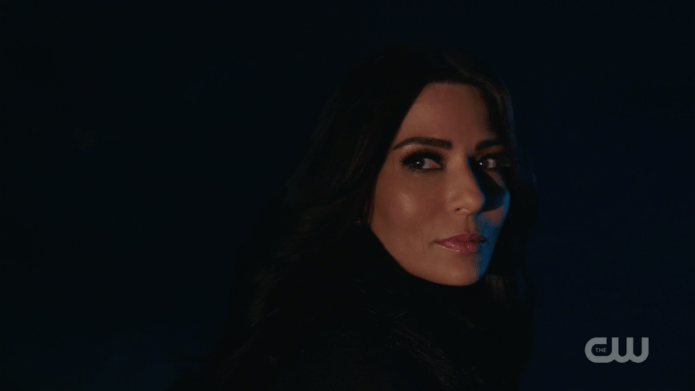
And perched on the edge of a cliff, the river frothing below, is not Hiram Lodge. Instead, framed by liquid sheets of dark hair, Hermione Lodge is “the boss.” It turns out that, as we suspected, Agent Adams was not, in fact, an FBI agent. Instead, he was a test for Archie – to prove his loyalty. And the phrase, “capo,” comes back from the beginning of the episode. Agent Adams was the capo of Hermione. But more interestingly is the role, the active role, Hermione appears to be taking. She is not, perhaps, the capo of her husband. She might be an agent of chaos in her own right.

Archie is confused, and betrayed. However, the test worked: Archie didn’t snitch. But with the steely blackness of Hermione’s eyes, it doesn’t feel like a victory. It feels like a warning: that Archie is not safe, not because of Veronica, not ever.

This is the first time that the Riverdale ragtags didn’t involve the police in something that’s happened, and it marks an unholy shift in the narrative for me. Before, they circumvented the (relatively) hapless law enforcement when they had to, but they still were operating on the side of good. Now, with so many people moving to cover up a murder, and some getting deeper into the pull of mafia, our heroes of Riverdale are taking a distinctly antihero approach.

Standard
Essay, Humor, Things Happening RN

I’M EAVESDROPPING

THURSDAY, STARBUCKS – I just spent twenty minutes listening to two teenager/twentysomething girls complain about their babysitting wards, specificially some kid named Soren. I kept meaning to start writing something, but I was drawn in beyond understanding. Soren dropped something on the floor and then just walked away. She would totally clean it up no problem, one girl assured, but it was the laissez-faire attitude Soren possessed that really irked her. By the way, that’s never true. It’s never that you would totally clean something up but the person was rude about it – you also don’t want to have to clean it up. But for some reason, it’s unacceptable to say, “I don’t want to clean up after you, Soren!” I laugh so hard at this fake, imaginary person who loves cleaning up after people but loves politeness more.

“Do the parents care?” “No. I mean, they get mad, but they don’t really do anything.”

I’ve been doing a lot of eavesdropping lately. Not necessarily on purpose, but it’s just been happening. I work at a moderately hipster, reasonably priced popular grocery chain. And what I’ve learned in the almost five months I’ve been there is that nothing makes you more invisible to people than working retail. People, bless their hearts, really are blind to you.

The other day, I was manning a register when, behind me, a customer was loudly monologuing about the upcoming Super Bowl. “Tom Brady’s so mentally strong,” she was trying to convince my co-worker who, bless her, does not watch football. “He’s totally mentally strong,” she shouted into the void. When I turn innocuously to catch a glimpse of her, she latched onto me. “You watch football right?” she asked without waiting for me to answer. It’s a minute later before I found a dip in the conversation to say, “No, not really.” She bore a more-than-passing resemblance to Jenna Lyons, the former creative director and president of J.Crew – slightly more mannish and full, but strangely magnetic.

Even after we’ve all affirmed that we, unlike her, do not watch football – I’ve watched one game this season – she continued to launch several rhetorical questions into the open air. Receipt in her hand, she kept going. Next customer being rung up, still she stood talking. And finally, when she said her goodbyes and pushed her laden cart out of the store.

Days later, she came to my register and started talking – mercifully, not about football. She was ranting about The Walking Dead before offering up, sans spoiler alert, “Yeah Carl was bitten.” And when I said, “Oh I don’t watch that show,” she repeated the spoiler, “Yeah, he’s the son. He’s annoying. He’s dead, well, not yet but he will be. That show’s really going off the rails.” To so brazenly offer up what was surely a pivotal twist in the series without even the slightest concern or spoiler alert – what if I were watching the show? – was shocking. When I offered up that I was currently watching The Crown, she pivoted easily and naturally. She had not seen the show but her brother-in-law was the owner of some football team and also an ambassador to the U.K. She dug up a picture of him meeting the Queen and attempted to show me several more Instagrams before the lack of Wi-Fi foiled her. She would, she promised me, show me the photos next time.

As she left, I had to fight a smile from creeping across my face. When I first escaped her football speech, I pictured what the rest of her day must look like, as I often do with customers. I pictured her talking the ear off of other mothers at drop-off; I pictured her loudly holding court at the dinner table. I pictured her as loving fiercely, but suffocatingly. But something about her vicious lack of wherewithal about name-dropping shifted my lens of her.

She just, bless, didn’t give a fuck. She wanted to name-drop, and so she did. She had opinions about The Walking Dead, so she shared them. She had an effusive admiration of Tom Brady, so she expressed it. It didn’t matter to her that no one shared in her journey; an audience was entirely beside the point. What I had interpreted as an inability to read the room was actually just blind conviction. And there’s something about bald and bold confidence that draws me to people. People so often step around how they feel, like those girls did with Soren. Instead of just saying, “Fuck off Soren, I’m not your maid, I’m your babysitter. Now clean up the floor,” she couched it in the way he (or she, the name Soren leaves the gender mysterious) handled the dropping. But I imagined that “Mentally Strong” would have no problem eviscerating Soren. And Soren would probably, eventually, be grateful for the straight talk.

People so rarely say what they mean. We’re wrapped up in manners and culture – it’s not necessarily a bad thing – but it was so arresting to see someone so unconcerned with the norms. A normal person would exchange meaningless banter at the register – their weekend, the weather, perhaps a recipe or two. But for her, all the world’s a stage.

Standard
2018, Review, Riverdale CW, television

REVIEW of RIVERDALE Ch.25, “The Wicked and the Divine”

Are we going to ignore that it seems literally impossible to “decapitate” a bronze statue?


Grade: B-

In things I never thought I would say: I’m completely intrigued by Jughead’s storyline so far. He’s gone from annoying emo Dan Humphrey to annoying Serpent to now intrepid journalist and activist-ish. He’s fighting against the corrupt powers-that-be: Sheriff Keller and Mayor McCoy. But while he’s also fighting the good fight, he’s being tripped up by his old, dumb decisions: namely Miss Penny Peabody.

It’s Veronica’s confirmation, as we can discern from her couture fitting of a white satin dress. When I was confirmed, I wore a one-size-fits all robe and sweated it out with two hundred other 12-year-olds. But to each his own. Veronica’s whole family is coming into town…her crime family. According to Agent Adams, this provides a perfect opportunity, ostensibly, for Archie to dig up some good dirt on the Lodges. However, Archie, newly apprenticed to the Dark Lord, is having trouble balancing his two boyfriends (a problem I’ve never had). He’s been invited to work Hiram’s poker game with other industry kingpins.

Veronica is afraid of bringing Archie into the fold, into the family. Outsiders aren’t usually allowed in, but Hiram sees something in Archie that’s different. And either Veronica breaks up with him to protect him, or she forever keeps him at an arm’s distance. Veronica is grappling with her future in the family: both as a moll and as a scion. But I’m wary of Hiram’s sudden acquiescence about Archie’s role in the family: is he really okay with Archie taking a greater part?

And when Veronica eventually decides that she does not want Archie involved, it may be too late. At the poker game, he overheard two of the kingpins plotting to get rid of Hiram, whom they felt had become too weak. So when he suspects them of attacking, Archie warns Hiram. Veronica attempts to warn Archie off, but he already knows that Hiram is a monster. But then something happens that makes me unclear about Archie’s motives. This entire episode, I was operating under the assumption that Archie, in spite of himself, was actually enjoying being Hiram’s disciple and when Veronica tries to warn his about Hiram’s future plans – of which SoDale is “just the beginning” – Archie stops her from incriminating herself. Is he still loyal to Boyf Numero Uno, Agent Adams?

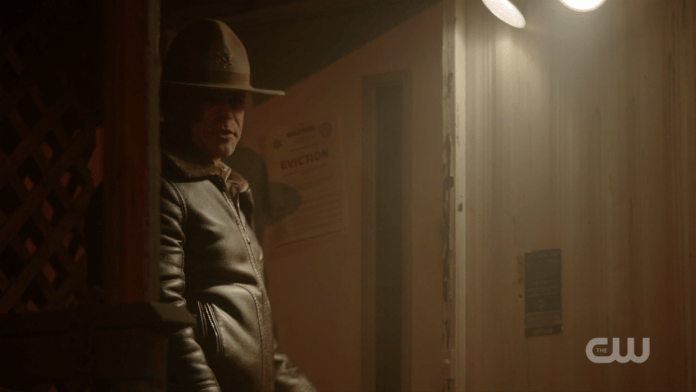
On the Southside, Serpents are being targeted as the suspects of defacing the General Pickens statue. Sheriff Keller regularly harasses Jughead and his friends with no evidence; Mayor McCoy allowed for the eviction of the entire trailer park. But the call is coming from inside the house. Those evictions spur Tallboy, who hates Jughead, to bring Penny Peabody, angry and irritated and tattoo-less, back into the fold for legal retribution. She, however, wants an eye for an eye: an end to Jughead at her own hands. FP, upon learning that Jughead skinned Penny’s tattoo and broke Serpent rules for attacking one of their own, says that Jughead will be the downfall of the Serpents. Okay, sis.

Juggie and Betty put up flyers to find the head, and get a call from a local scrap company. Someone’s found the head. When questioned, he admits to seeing someone unfamiliar around the scrapyard. In the most obvious twist, it’s Tallboy. He set up the decapitation, possibly with the Lodges, to bring Penny back and get rid of Jughead and FP, allowing him to take control of the Serpents.

Eventually, Papa Poutine, one of the kingpins that tried to get rid of Hiram, has been found dead and the Lodges get a cumbersome confirmation present: the head of General Pickens. Could it be that the Serpents know Tallboy co-operated with Hiram and now they’re taking their revenge?

In all of this drama, Betty’s induction into the world of cam-modeling seems relatively underplayed. If this were anything else, it would be the major storyline, but when I’m watching her and Chic, I can’t even muster up some energy. Betty’s “dark” side is being messily underutilized, and besides the fact that, like, she’s sixteen and that’s totally illegal for her to be a cam-model, I’m just not that interested. I don’t want to explore her darkness in a vacuum. Also Hal, who may or may not have fucked Penelope, refuses to live under the same roof as Chic, is going to a “Share B-n-B.”

Betty is more compelling when she’s putting her Nancy Drew skills to the test, and even more compelling when that puts her morality – and Dark Betty – in question.

And just when Betty and Jughead seem to be rekindling their flame, the lingering omission of her webcam life hangs between them. An omission that might come to light when one of Chic’s, or Betty’s, clients knocks on the Cooper door. A visit that ends with Alice Cooper cleaning his blood off her lacquered wood floor.

Standard
2018, Review, Riverdale CW, television

REVIEW of RIVERDALE Ch.24, “The Wrestler”

Slim Pickens


Grade: B-

Essentially, Riverdale is a show about the power of journalism – that and bizarrely hot high schoolers. The Riverdale Register and the Blue-and-Gold play crucial roles in exposing the seedy underbelly of Riverdale.

Things are reaching a boiling point; Archie is trying to balance sports with being an undercover FBI mole; Cheryl’s mother is running a brothel from their cottage; Veronica is training to be the scion of the Lodge family criminality; Betty is grappling with her newfound brother; and Kevin is running track, wrestling and writing a gossip column! Shockingly, minus the wrestling and the cruising for dick in dark woods, Kevin is me in high school.

The entire episode is framed around Pickens Day: a day to honor General Augustus Pickens. He, bankrolled by Cheryl’s ancestor, settled the land that would one day be Riverdale.

While Cheryl is petitioning to get it renamed to Barnabas B. Blossom Day, the Adults are using it to their advantage. Spurred by the bad press of closing Southside High, the Lodges and Fred Andrews want to sponsor Pickens Day to restore goodwill amongst the So-Dale project. Mayor McCoy, who is getting sudden nosebleeds from the high horse she’s decided to clamber onto (despite banging the sheriff and taking Lodge hush-money), is strongly against it. Also her name is Sierra?

It turns out that General Pickins operates as Riverdale’s Christopher Columbus: honored in the present because of efforts to whitewash his bloody past. It turns out that Toni and other Serpents are the descendents of the Uktena people, who were the original inhabitants of the land that would be Riverdale. But Great-Great-Great-Grandpappy Barnabas B. Blossom (a real Hiram Lodge) wanted the land for development (the maple industry, brothels, saloons and railroads), and hired General Pickins to slaughter the Uktena, 400 people.

Veronica, at the end of the table, casts her vote for bolstering Pickens Day, when Archie comes home. Drama! When he reports this development to Agent Adams – gay love affair – the FBI agent urges him to cozy up to Hiram Lodge by any means necessary. Archie, after learning that Hiram loves wrestling, decides to go out for the wrestling team. Basically, this episode is largely stagnant and dull, but gives us ample shots of Archie being hot. It’s a win, people, except that Archie kind of sucks at wrestling (even Kevin can pin him down, albeit later calling Archie a “1970s’ pornstar”). By the way, Kevin is a straight-up freak and I love it, because it leads us into Betty’s B-plot.

She learns, via Kevin, that Chic is a cam-boy, a digital gigolo, a virtual hooker. This is where I get a little preachy. Chic was put up for adoption, aged out of the foster care system and received no handouts from anybody. What he does to make money is of no business to anyone, least of all the rich, well-to-do famiy that decides to drop into his life unannounced. Although I’m not here for him introducing Betty, who is…16? 15?…to cam-life, or as Jughead refers to it, “The Dark Education of Betty Cooper.”

Betty and Chic bond over their weird rage-flashes and tendency to dig their fingernails into their palms hard enough to draw blood. She’s especially protective of him against Hal, who is, by the way, definitely not the father of Chic. That divide in the family deepens enough that, after a full-out fight on Pickens Day, Hal falls into the treacly company of Penelope Blossom.

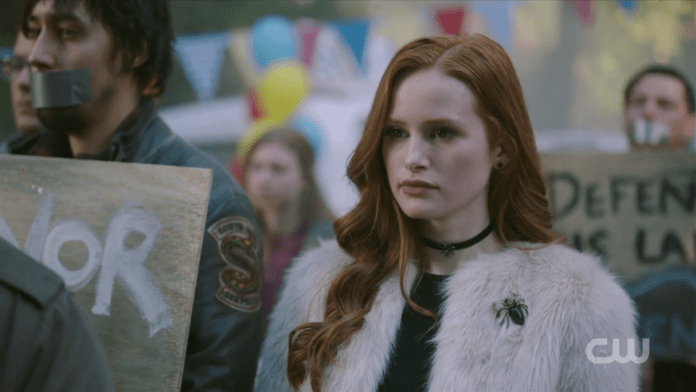
The rest of the episode plays out like this: Jughead uses the plight of the Uktena to write an article (journalism!) lambasting Pickens Day as the celebration of slaughter (in the process angering Toni for “using” her grandfather) before all the Serpents protest the festival and, allegedly, desecrate the statue of Pickens.

Archie trains privately (gay) with Hiram Lodge, sinking deeper into treacherous Lodge waters as he defeats Chuck Clayton (remember him?) and earns the respect of Hiram. Oh and Mayor McCoy’s high horse gets in the way of a Josie-Veronica friendship, culminating in the band, “Veronica and the Pussycats.” Oh, and Cheryl realizes her ancestor was a bloodthirsty monster (are you really surprised, Cheryl? Look at who everyone else in your family is!), thus opening up the potential for her to approach Toni.

In the end, Archie denies a call from Agent Adams in favor of chatting with Hiram Lodge, leading us to wonder, “Is Archie getting too deep into the Lodges?” Is he infiltrating or converting? Upon a second watch, I noticed a squid lapel pin on Hiram’s suit. Could Archie be caught in the clutches without him even realizing?

I didn’t love this episode because, despite the ~drama~, it really operated to set up other shoes to drop later on.

Standard
Humor, Life, Mental Health, Things Happening RN

Lol – I’m Depressed

It was probably the eighth time that I went to open a Word document to write a blog post, hovered over that blue W and then flicked my finger away that I realized something was probably wrong.

It was probably when waking up left me feeling more tired, the kind of deep, head-wrapped tired that dips your bones in wax.

It was probably when the thought of sending an email filled me with enough anxiety to justify binge-watching the latter half of Real Housewives of New Jersey. (I also just, like, had to do this. Siggy is crazy, y’all).

It was probably when depression curled itself around me like an angora sweater-shawl that I realized something was up. A blend of cashmere and sadness.

Depression is weird because even when you have a “handle” on it, it can still surprise you. I’ve been in therapy on-and-off since I was fifteen; I’ve had ups and downs and I thought that I was pretty solid on my mental health. Even so, I would be surprised to realize that the few “bad days” I was having, where nothing seemed to go right and my thoughts couldn’t be quelled, were small depressive blips.

In lay terms, I often describe those blips as a common cold. It knocks you out of commission for a few days; it makes you a little fuzzier and a little slower; you don’t realize it’s happening until it’s almost over. But, in the same way that a healthy person always seems a little in denial that their body is fallible, I’m always a little naïve that I can fall prey to these blips.

This last time has been more than a blip: a blap, perhaps, or even potentially a bloop. Depression is wild because it completely changes your way of thinking and distracts you from itself. It’s the Cheshire cat of mental health: me not being able to write a coherent blog post, or answer an email suddenly gets attributed to other things – I’m not funny or talented, or I still can’t figure out if “Best, Danny McCarthy” is going to be my email signature. It took a few days/weeks to realize, “Oh, it’s been you beside me all along.”

I live for a romantic comedy, but not one that ends with me and Depression kissing in a gazebo.

This bloop was brought on by a myriad of things, none of which were particularly noteworthy or memorable in and of themselves. I’m applying to grad school and wading through applications. I’m working. I’m trying to find a psychiatrist. I ran into my major high school crush whilst at my day job when I was underslept and overshaven. I’m living in my childhood bedroom. I graduated from college and I’m spiraling.

There’s no real button to this blog post that’s neat or clean. I’m still having a bloop; and I’m doing self-care in the ways that I know how: forcing myself to write, doing pull-ups and listening to a lot of Kelly Clarkson. I think it’s important to write this because I often feel that whilst I’m in the moment of a bloop that I can’t talk about it: better to wait until it’s over and then I can be triumphant and saintly and tough. But that’s not realistic, and that’s not relatable. And as much as I worry that these seem like “Cry for Help” posts or pity parties, I know that they’re not. I’m fine now, and I’ll be fine later. I don’t want to wax poetically about how I “made it through, and you will do.” I know I’ll make it through, and I know you will too, but hon, we’re here for the moment. Might as well lean into that angora and be honest.

Standard
2018, feminism

Man to Man: What Men Can Do

In the aftermath of the 2018 Golden Globes, where women (verbally and sartorially) expressed their anger, hope and sadness surrounding the #MeToo campaign and the Time’s Up fund, there was a lot of criticism leveled at the male celebrities who, besides wearing “Time’s Up” pins, were noticeably silent.

Some men offered the explanation that they wanted to give the platform to women; they did not want to overshadow women; they did not want to mansplain. But what men don’t understand is that they, we, can use our various platforms to educate and call out other men to be better friends, allies, lovers and peers. We cannot, and should not, expect women to change an entire culture single-handedly.

So here are some things that I, as a man, think other men can do to express support.

1). If you hear something, say something:

Harassment takes a lot of forms. It can be sexual, workplace, verbal, nonverbal. It doesn’t even have to take place in front of women. If you’re with your male friends, and they’re speaking inappropriately, condescendingly or rudely about a woman or girl, say something. We have access to spaces that women sometimes don’t, and, unfortunately, we can have undue influence over other men simply because of our gender. So if you hear something inappropriate, your silence is a sin of omission. It doesn’t matter if you did not say anything. By saying nothing, you’re cosigning their action.

2). Listen:

Men are born with such levels of privilege that we are often unaware of how much it plays into our everyday life. If a woman, person of color or gender-nonconforming person tells you something, just listen. You don’t have to fully understand why it’s upsetting, but you have to acknowledge that it’s upsetting to them. There are certain things I’ve experienced as a queer person that, when complaining to heterosexual friends, didn’t seem to cross that boundary. Don’t minimize or attempt to explain away. Just because it doesn’t happen to you doesn’t mean it doesn’t happen at all.

3). Seek consent:

This applies in a major way to sex. Seek constant, enthusiastic consent. Consent is not a one-and-done thing; keep asking, keep making sure that your partner is actively consenting to whatever you’re doing.

4). Understand your own language:

This in particular can be applied to gay men, and especially white gay men. We are oftentimes guilty of being misogynistic towards women. It might fall under the radar or be explained away by “cattiness” or “sass.” But being gay does not give you a pass to demean, disrespect or condescend women. Any man calling a woman a “bitch,” “slut,” or “cunt” is being misogynist, regardless of his sexuality.

5). Don’t cosign gendered behavior:

It’s easy to fall into gender tropes, and to pass those along to children can be incredibly damaging. It might be as small as complimenting a little girl on her clothing, but saying how “tough” a little boy is. Avoid romanticizing kids (i.e. “Is that your boyfriend/girlfriend?”). They’re kids, dude. Allow boys to be vulnerable; let them express their emotions. If we teach boys to suppress their emotions, say that being emotional is feminizing, or urge them to be “big boys,” what we’re really saying is, “You don’t deserve to have emotions.” That pain, sadness and anger comes out regardless, and can be leveraged against women and girls.

6). Promote women:

Look at your Twitter timeline. Is it all men? Is it all white? Starting small, like following people of different genders, races, socioeconomic statuses and political affiliations, can fundamentally change the way you think by exposing you to different perspectives. Read the work of women; retweet them; highlight them amongst friends.

7). Confront your own thinking:

There was a time when I realized that I was uncomfortable at the sight of my female friend’s nipples poking through her shirt. I ignored it for a while, until it came up in conversation and we talked about it. Even as you actively try to be feminist, you grew up in a society that suppresses female sexuality. It’s okay; we all did. Understanding why things make you uncomfortable does not make you a bad person. It means accepting that we all have been damaged by our upbringings; it means that, once recognized, we can change our thinking. Try to understand why you think something; analyze whether that’s valid or not; adapt accordingly.

Understand that, consciously or not, you have probably participated in harassment of women. Understand that, and work to change it.

I’m ending with the closing paragraph of an article Roxane Gay, a celebrated feminist, author, writer, and social commentator, wrote for the New York Times on October 19, 2017:

“Men can start putting in some of the work women have long done in offering testimony. They can come forward and say “me too” while sharing how they have hurt women in ways great and small…It’s time for men to start answering for themselves because women cannot possibly solve this problem they had no hand in creating.”


Below is a list of women that I follow on Twitter whose work, opinions and writing inspires me, challenges me and calls to me. If there is a woman who you think I should be following, please let me know!

Maggie Haberman, White House correspondent for the New York Times

Roxane Gay, professor, writer, author

Patti Harrison, comedian

Janet Mock, writer, producer, activist

Evette Dionne, writer, editor

Parker Molloy, writer

Ashley Nicole Black, comedian, television correspondent

Celeste Yim, comedian

Karen Attiah, Global Opinions editor for Washington Post

Ijeoma Oluo, Editor-at-Large of The Establishment

Kamala Harris, U.S. Senator

Erin Gibson, writer, comedian, podcaster

Standard
2018, Review, Riverdale CW, television

Review of RIVERDALE Ch.23, “The Blackboard Jungle”

What’s with the backpack situation in Riverdale?


Grade: A

Riverdale is back! And all the dominos set up in the former half of the season are getting knocked down in the latter.

With the Black Hood unmasked (theoretically, I don’t believe it) we can move onto the mysteries of Lodge Industries. I personally would love a refresher on what they’ve done, but from what I can glean: Hiram Lodge, during and after being released from prison, has been using the Southside Serpents to depreciate land value in Riverdale and then swooping in to buy the land for development and gentrification. There also seems to be a drug element that wasn’t resolved before the mid-season finale, so I have to assume that that’s emanating from Casa Lodge.

But with the Black Hood nightmare over, the citizens of Riverdale are finding other ways to occupy their time. Utilizing Archie’s sleuthing, the FBI has sent a former Riverdale resident to recruit him into taking Hiram Lodge down. Despite the fact that Archie did nothing to solve the murder of Jason Blossom or the mystery of the Black Hood and that Betty did everything, the FBI is interested in him, mainly for his connection to Veronica and his own father’s involvement in Lodge Industries.

As an aside, the scene between FBI Guy and Archie could play equally as well as the introduction to a multi-episode gay porn arc. Agent Adams (gay) wants a few simple things from Archie: investigate the Nick St. Clair (Sinclair?) accident, and a deeper understanding of Lodge Industries.

Due to some nefarious dealings between Mayor McCoy and the Lodges (damn, they’re really earning their paycheck this season) Southside High has closed and its students are being move to Riverdale High. Normally, in comparison to teen murders and serial killers, normal storylines like school district consolidations would be a total bummer. But I’m just so glad that these kids are in class – I was worried about their college prospects. Now I’m just worried about the disturbing lack of backpacks amongst the Southside students.

And so while Veronica (who knew from her parents that Southside was closing), Archie and Betty are welcoming towards the merger – even as it muddies the water of a Bughead break-up (was it a break-up?) – others are not as enthused. Cheryl Blossom, backed by Reggie (hot) and a coterie of cheerleaders (a swarm of cheerleaders? A gaggle? A culture?), is using dog-whistle language to lament the loss of Riverdale’s above-average GPA. This seems oddly out of character for Cheryl (she’s a bitch, not a racist) so here’s my theory.

First, Cheryl is deeply insecure, and hates any change. Second, she’s also self-conscious of her own family’s changing socioeconomic status.

But at the core is the squaring off between Toni Topaz and Cheryl. Before the season started, the powers-that-be suggested that Cheryl would be getting an unexpected love interest. Basically, that’s code for “queer.” Now that we’ve seen Cheryl’s weird love for Josie, the stage has been set for a same-sex Cheryl romance. I’m here for it – Cheryl’s never read as particularly “straight” to me, and her kissing Archie at the end of season one felt much more like a desire for closeness than sexual tension.

So while Cheryl amps up the anti-Southside sentiment (leading to stricter censorship of Southside regalia, Jughead’s suspension and a burgeoning possibility of romance between Kevin Keller and Southside’s Fogarty – could we be getting two queer romances for the low, low price of $9.99 a month?) Betty’s B-plot involves the Mysteriously Pregnant Polly who is no longer Pregnant. Post-natal Polly has given birth to twins (“Juniper and Dagwood”) without telling the rest of her family. To make it up to her mother (?), Betty decides to locate Alice’s long-lost son.

They discover he’s living two towns over and his name is Charles. Against Hal’s express wishes, Alice and Betty visit him in his hollow-cheeked glory. Charles “Chic” Smith is doing some shady work making people’s “fantasies” come true and is appropriately resentful towards his birth family. After a tense first meeting, Betty goes back to the apartment complex only to find her brother being stabbed by a strange, hulking man. God, what isn’t gay porn in this show?

Inevitable creepiness (including some Chic standing over Betty while she’s sleeping – light fare) ensues, and that’s the that on that. Until next episode (!!!).

Archie uses Cheryl as a red herring in order to get close to Nick. I’m really hating how people keep using Cheryl (and her assault) as means to an end. In an attempt to get her mother to stop hustling (literally being a “courtesan”) Cheryl will do anything to get that money, even reliving painful memories and gifting Archie the blazer of her dead, hot brother.

Under the guise of getting Nick to replicate that hush money, Archie somehow scrounges up the money to fly to New York to intimidate Nick. His goal is to get Nick to admit that the Lodges broke his legs for attempting to rape Veronica.

Side note: there are a lot of layers to this, but let it not be forgotten that the Lodges were fine with Nick when they thought he just attempted to rape Cheryl, but broke his legs when they found out what he had done to their daughter. Rape culture, y’all.

Nick taunts Archie; Archie breaks Nick’s nose; and despite getting the hush money, the trip is painted as rather fruitless. Agent Adams admonishes Archie for getting “sloppy” and Archie does not get Veronica to admit that she told her parents about Nick’s assault on her. And when she turns the tables – sensing that he’s lying to her – Archie uses the fact that Cheryl (technically) blackmailed him into helping her under the threat of releasing the secret of Archie kissing Betty. Given the town they live in (with rapists, drug dealers, and serial killers) and the fact that all parties were single, Veronica has an annoyingly overblown reaction. “You kissed?” she asked, in the same diner where, weeks earlier, Archie’s father had been shot point-blank and left for dead.

In the last, lingering moments of an incredible episode, Archie gives a voice to something that we’ve (me’ve) all been thinking. “In your expert opinion, Agent Adams,” he says, his caveman-hot brows drawn close and his voice gravelly, “do you think we got the right Black Hood? Because I’m not so sure.”

Season 2B (is that what we’re calling it) is off to an epic start. I cannot wait to see what else is in store. I really enjoy that the mystery of the Black Hood lingers, but I’m excited to dig deep into the Lodge drama.

Until next time, think about the fact that no Southside Serpents had backpacks and the only one was a Coachella-appropriate red number from Cheryl that would only fit a popper and some Kleenex.

Standard
Essay, Life

GREATEST HITS

“That’s where I made out with a girl watching Julie & Julia!”

“That’s where my grammar school best friend lives. He’s hot now.”

“That’s where I played football and prayed for a broken finger.”

“That’s a Wendy’s.”


Over the weekend, some college friends drove down from Boston and stayed with me. To give them the biggest bang for their buck, I assessed my town and the surrounding area for the Greatest Hits of my life.

Theoretically it’s not difficult. I live in a historically-significant area, full of ancient churches, old big-money family castles and interesting architecture. It’s also thirty minutes from New York City, but I’m not outsourcing my hometown pride to Manhattan. Not chic. I planned out a weekend that catered specifically to my friends: food-centric, a little bit lazy, and nerdy. They’re so lucky to have me, I s2g.

But in planning that weekend, I rediscovered my hometown and my own emotions towards it. I moved to my town when I was eight, entering a new school halfway through the year. This is a fact that I have repressed and forgotten until writing this.

Being the new kid, coupled with the fact that I was un-athletic, annoying and gay, marked me instantly as different. I moved into the suburbs, where the boys balanced sports the way I do Kardashian gossip Instagrams (see, I’m so gay – just picture that in the third grade). Eventually, I made some friends and settled in, but I always felt like I smelled new, different. Kids sense difference intrinsically, like dogs and high notes, and it was made clear to me that I was never a native. Eventually, I grew up and stopped caring, and went to high school and college.

In the weeks before, and in the days during, showing my friends around forced me to take a critical look at where I lived. Whenever I was somewhere interesting, I made a mental note to show it to my friends.

Days before they arrived, I took my dog to a nature preserve. I’ve been going there forever, and it’s a special place for me. When I was a kid, I used it to project my fantasies (epic wooded battles, or tense discussions echoing over the frozen lake water).

Ten steps into it, my dog refused to walk. Rather than go back (I used gas, sweetie – you’re walking on this path) I scooped him up and put him in my coat. He’s small, but thick, and so as I walked (arms aching) around the lake, it triggered one of my earliest memories of the preserve.

When I was nine years old, my family took the same nature walk. We had just gotten the dog. It was snowier then, and he was smaller. I unbuttoned my jacket (denim, lined with Sherpa) and nuzzled him against my shirt, buttoning the jacket over both of us. He was probably not even six months old then, and here he was again, thirteen years later, pulling the same shit. It hit me, all at once, how long I had been walking this exact nature path.

I remembered that jean jacket. A classmate, whom I later found out had a massive crush on me, negged me by telling me her brother had the same jacket but found it to be too feminine (not that that stopped me, honey). I also remembered holding my dog in that same coat one winter and him vomiting wildly over it.

Later, driving around with my friends, I pointed out different places – where I ran track; the field where I, at eleven and weighing as much as a small bird, played football as a defensive lineman and spent the entire season praying for a broken finger. The movie theater where I made out with my first (and only) girlfriend. The houses of childhood friends. My grammar school and corresponding parish church. The Starbucks where my mother and I had our first honest conversation after I came out of the closet. We drove along the Hudson River, and I pointed out the park I went as a teenager, the houses I had campers at during the summer, the high school where I went to one, very awkward high school dance.

I had never let myself settle into my town in the same way I had with my summer camp: a constant regardless of where I lived. I measured my life in those summers, where I started at three and worked until I was 21. The friends, the enemies, the moments. When I think of my childhood and early adulthood, that’s where I go.

But, in spite of myself, I had formed a sentimentality around my town, the school, the fields, my house. Even carrying that New Kid scent, I had formed memories in this area. These places were honeycombed with memories: pediatrician’s offices, hay rides in chilly October, hikes throughout my life, kisses and tears and tantrums.

Showing someone else your town, trying to expose the beauty and the specialness beneath the mundanity, felt a lot like taking stock of your own self. I had grown up here; I had evolved here. It’s something I took for granted forever. Since moving back post-graduation, I’ve had a complex relationship with my hometown (it rings a little too close to Failure to Launch, and if anything, I’m the Sarah Jessica Parker of my universe). But taking other people through my childhood sentiments, I warmed to my places in a way that I hadn’t realized.

Standard