Humor, LGBTQ, Love & Romance

IT WASN’T HARD TO TELL I WAS GAY, I PLAYED WITH POLLY POCKETS

I don’t know if it’s the fact that my love life is as barren and devoid of life as Antarctica (which means “no bears” because “arktos” is “bear” in Greek and “a” or “ant” means “without”—it’s called the alpha privative—and which coincidentally is probably a good example of why I’m without love; because I love Greek etymology and the cool kids who had sex in high school probably only like cigarettes and nothing) or if it’s the rampant repression in my family, but the last time my mom and I talked about a relationship of mine, I was freshly fourteen.

She was driving me across town to hang out with my cool friends and the route took us past a huge cemetery. While driving past the cemetery, my mom asked me if I was going to give my girlfriend—yes, that’s not a misspelling—the bag I had bought for her—I just accidentally typed out “him” because my body is rejecting the notion of heterosexuality on base instinct, it seems—while we were in London over the summer. It was my first European excursion and I had spent some of my meager allowance on a tote bag—in a sensible ecru emblazed with red and blue ‘LON-DON’—for the love of my life. Unfortunately before I could give her the tote bag, she broke up with me via AIM. I might be dating myself with that reference.

6af0b52bf507795720e1ba4d70b37b89

A few months passed, and my mom was driving me to a casual hang with my now ex-girlfriend and our mutual friends. I can’t remember the details—selective blackout—and the friendships soon dissolved after that as I realized I was wildly and deeply swimming in the dude pond. “What happened?” My mom asked, concerned that her heterosexual son had ended his first heterosexual relationship, heterosexually.

Years later while heading back up to school, I was walking along the bridge that spanned the wide expanse of train rails when I saw her sitting on the floor, long legs curled underneath and looking flawless without makeup, with her new boyfriend, who I can’t remember—again, blacked out—but I’m pretty sure was the live-action inspiration for Prince Eric. Glad she’s happy. I walked past with my head angled the other way because the only thing worse than confronting your old girlfriend that you’re gay is confronting your girlfriend with her hot new boyfriend that you’re gay.
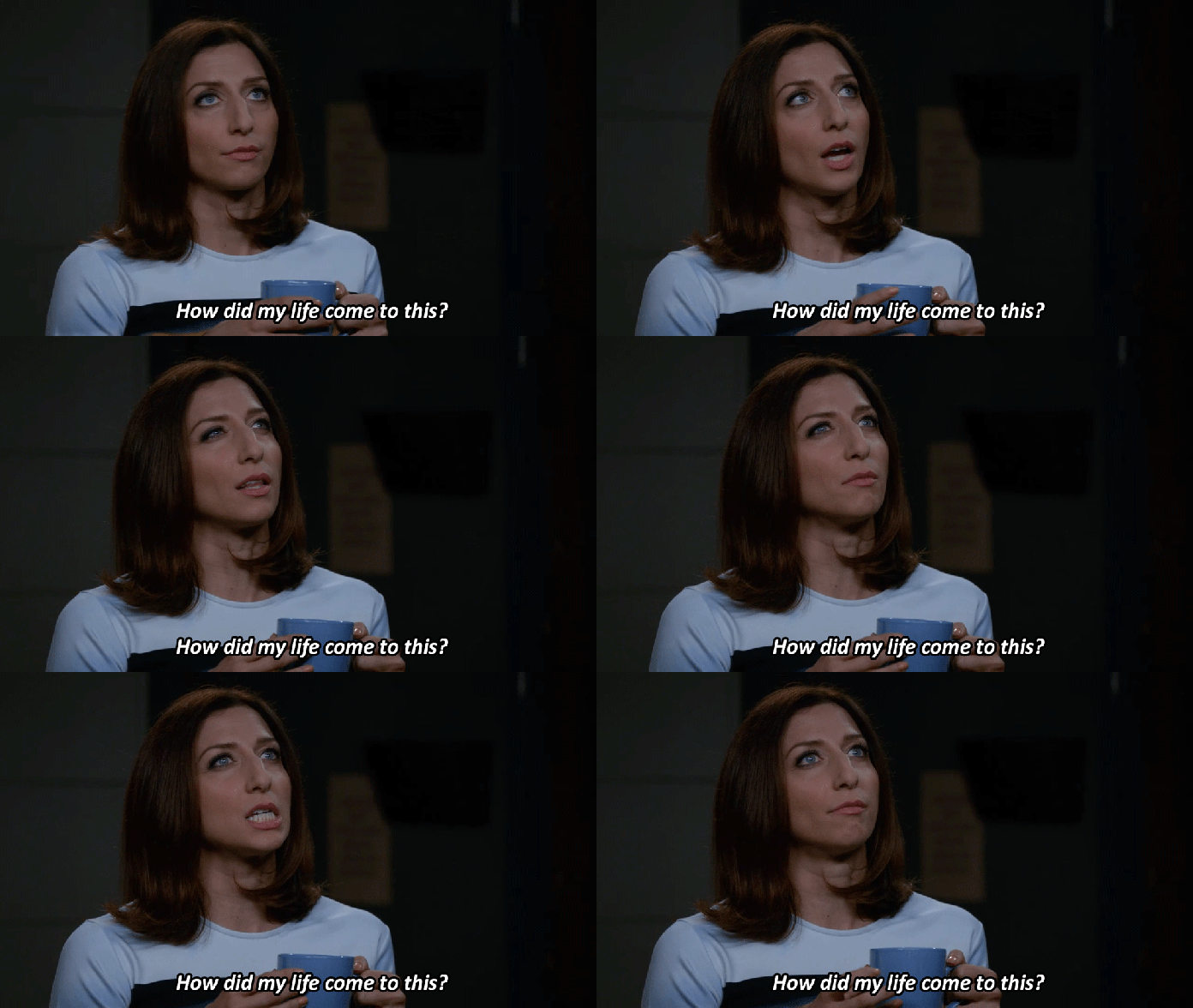
I was talking to some old (ish) friends the other day and I was relating the tale of dating my first (who am I kidding? Only) girlfriend. “I remember being twelve and dating her and being uncomfortable. I brushed it off as thinking that I was a “free spirit” and couldn’t be tied down in a relationship,” I said, pausing before adding, “That was a lie; turns out I was just very, very gay.” Wait for laughter. Be emotionally fulfilled by others’ external laughter noises.

During the conversation of the tote bag—custody arrangements were later made in the best interest of the tote—I was fourteen and for the next year, I steadfastly ignored the rising feeling that lingered underneath layers and layers of Irish repression and fear. I became permanently tense and headaches plagued me from the sheer effort of keeping the lid on my homosexual (porcelain, gilded) box. Finally, at fifteen, in the shower, I realized I was exhausted. “Fine, I’m gay,” I’m sure I said, face directly in the showerhead so that the gurgle of water blanketed my voice. And instantly, some of the tension let out and I unspooled from my sharp wire coil.

Something I learnt after I came out was that, apparently, everyone already knew and was dying to tell me. “I always could tell,” said one well-meaning, slightly condescending person after another. I played with Barbies until I was eight, wore a cape for a year when I was five, and routinely claimed that Prince Eric was my husband. Excuse me if I don’t doff my cap for your super-sleuthing and Holmesian detective work. If I sound bitter, it’s because I am. There’s nothing more disappointing to a theatrical gay that’s having potentially the biggest moment of his life than to find out that everyone already knows his big, juicy secret.

There’s also nothing more useless. In my Film Theory and Criticism class this past spring, we were reading incredibly dense theory by Slavoj Zizek, who I hate with a fiery, unrepentant passion, and someone asked a question about a particularly dense passage. My professor laughed and said, “Oh that’s so confusing. I have no idea what he’s talking about. That’s not really what I wanted you to focus on.”

The students looked at each other before the girl who asked the question raised her hand again and ventured, “What were we supposed to focus on?”

If I actually did the readings for that class, I’m sure I would’ve been as upset as the other students when they found out that instead of struggling through the theory for hours, they could’ve just focused on select passages. That sucks, guys; you totally have my sympathy.

See, that is some information that would’ve been handy before the fact. That would’ve made a difference. You telling me three years after I came out that you’ve “always known” and telling some charming story about me, I don’t know, making dresses for my Polly Pockets—which is a real thing that I did—is decidedly not helpful for me, neither before nor after the fact. Please keep the fact that you figured out my sexuality when I was four to yourself. It’s not needed. Thanks, but no thanks. The whole practice, the “Of course I knew!” routine, is largely demeaning and unfair to all queer people, who have struggled to come to terms with their identities for years.

In an effort to avoid the whole rigmarole of sitting down, finding the words and coming out to people, I’ve instead usually opted for the secondary route of loudly proclaiming which guys—celebrity, make-believe, or otherwise—I think are hot. It’s a method that has proven relatively successful for me, unless the person I’m talking around is deaf or one of those people who think that wrestling isn’t gay or that guy who says, “What’s better than this: Guys being dudes” in that video. Those people are deliberately obtuse. Also I don’t know the word for “gay” in American Sign Language. I could improve, but I don’t think that would end in any other way but a lawsuit.

“We just didn’t work out,” I sighed to my mom vaguely at her question and went back to staring pensively out the window at the passing blurs of cemeteries, thinking about wrestling.

Standard
LGBTQ

A REACTION TO THE ORLANDO MASSACRE

I’ve debated for the last 24 hours whether to address the Orlando massacre today. On one hand, I feel helpless to do anything and that helplessness has made me wonder if one more article will do anything. It seems impossible in the wake of such a tragedy.

But on the other hand, I am filled with such an anger, at the shooter, at the reaction on Facebook, and at our government, that I think to say nothing would be to be tacitly supporting false ideas. And fuck that.

The shooter, Omar Mateen, targeted a gay nightclub during Pride Month. He specifically targeted the LGBTQ+ community, marking this as not only the largest massacre in U.S. history but a hate crime of horrific proportions. The shooter was American, born in New York. The shooter legally bought his weapons. He was, according to his ex-wife and family, not particularly religious but that is something that I cannot prove or disprove. Allegedly before he attacked the nightclub, Pulse, he called 911 and pledged his allegiance to ISIS.

As a queer person, I am sickened and saddened and distraught at the loss of so many members of my community. Pulse was a nightclub, and nightclubs have been, historically for LGBTQ+ people, safe havens. We have gathered there, rallied there, found strength there, and found community there. To attack in a nightclub, Mateen struck at the very core of our community.

But watch, in the coming hours, days and weeks, how our government reacts to this tragedy. They will focus on ISIS, or on fanning the flames of xenophobia, or proclaim him to be “mentally unstable.” They will offer thoughts and prayers. We don’t need your thoughts and prayers. We need, from our government officials, action. We need them to change our laws.

I don’t need politicians like Ted Cruz, Donald Trump or Carly Fiorina to offer their “prayers” for a community that up until the attack, they called rapists, pedophiles and deviants. We don’t need those kinds of prayers. They will offer sympathy because it is what is expected of them, but memory is a long thing. I don’t need people who destructively limit women’s access to abortion clinics but allow for lax gun control policies to offer sympathy. You don’t get to protect one sphere of life while leaving another to die. You don’t get to pick and choose.

Watch how our presidential candidates react to this tragedy. Watch if they shift the focus from the necessary conversation about stricter gun control to inflaming hatred against Muslims. See what they say, what they promise.

I need our politicians to finally decide to change laws. Don’t give me bullshit about the Second Amendment, or that if the clubgoers had guns they could’ve fought back. If you want to abide exactly by a centuries-old document to the detriment of Americans, give up electricity while you’re at it. Commit.

I am angry because nothing seems to be enough. Sandy Hook wasn’t enough. The shooting in the movie theater wasn’t enough. Nothing is enough for politicians to stand up and decide to change laws. How many times does President Obama need to get up to that podium and deal with such tragedy before lawmakers decide to change?

Our politicians, our democratically elected politicians, are telling us that our lives are expendable. That our safety is worth less than preserving some ancient tome. I won’t stand for that. I don’t want to exist in a country where in 2015, there were 372 mass shootings.

Thoughts and prayers are kind and appreciated, but that time has passed. We need direct action from our government. Don’t hide behind xenophobia and Islamophobia. Don’t say that this is unrelated to gun control laws. Own up. Take responsibility.

To everyone who was affected by the Orlando shootings, I am so deeply sorry. I am sorry that you went to what you thought was a safe space and were attacked. I am sorry that we could not protect you. I am sorry to your family members, who woke up to terror and confusion. I am sorry that we did not do enough.

This attack was done during Pride. Gay Pride is not just a celebration of being gay; it is a political statement, a show of strength in a world that condemns us and vilifies us. It is not just about rainbows and love; it is showing that we still face extreme prejudice and violence, and that did not end with marriage equality. It continues every single day.

I am proud to be gay. I am proud to be queer. I will not be cowed by violence; I will not be bullied into silence. The LGBTQ+ community has existed and persevered in the face of extreme danger forever. We have done that because we are stronger than that; because we refuse to break. Remember that in the coming days and weeks. We are strong; we are united. Remember those who died at Pulse and remember why we continue to fight.

#PrayForOrlando.

Standard
LGBTQ

WHY “FLAMBOYANT” IS THE WRONG WORD

The other day, I was put in the position of having to explain what The Wunderkindof was to someone who had never read any of my work (also “work” is purposefully vague, since most of my posts consist of me transcribing my word vomit). If you’ve ever had to advocate yourself to someone who doesn’t know you, the act is masturbatory narcissism.

“It’s…funny…? It’s like…politics…and pop culture…and my thoughts…?” I said, like I was waiting for her to tell me what my blog was. Our mutual friend stepped in and described it as a sort of “flamboyant Jon Stewart.”

The second half of that compliment almost made me forget the first, because being compared to a late night host is as close to me weeping of happiness as I’ll probably get. But the first half of the compliment made me uncomfortable, as the word “flamboyant” always does.

Flamboyant. It’s been frequently assigned to me. When you have a voice that increases iN VOLUME AS YOU GET MORE EXCITED, and know anything about fashion, and you are a guy who’s into guys, then you run into this term often.

I actually Googled it before starting this post, because I’m not pulling a Michael Scott (get that reference?). “Flamboyant: tending to attract attention because of their exuberance, confidence, and stylishness; (especially of clothing) noticeable because brightly colored, highly patterned, or unusual in style.” Sure; I get why it’s associated with gay people; if you’ve seen pictures of me in high school, then you know that I was the pinnacle of “brightly colored” and “unusual in style.” The unusual part was that I didn’t have any style (drum and cymbal noise).

And I don’t even blame my friend for using that word. Because I don’t think she knows why it would be offensive. And truly, I didn’t know until I had really thought about it. Why it rubbed me so the wrong way. But I did. And now I know.

I make no attempt to disguise being gay. I regularly discuss boys and liking boys and being a boy. This isn’t “gotcha” journalism. It’s “duh” journalism. Imagine if I were straight. Just for a second.

Imagine a straight me, writing about politics and pop culture and music and—and this is important—dating relationship perils with girls. He wouldn’t be called “flamboyantly straight.” It wouldn’t even be noteworthy. But the fact that I am outwardly myself, and that being “myself” means being gay, it implies that being outward is somehow being flamboyant. But if I were straight, those same blog posts replacing a “he” with a “she” would never be called “flamboyant.”

And so the thread comes back to societal internalized homophobia. This notion that being openly gay is being “flamboyant” when being straight is just being normal. Not even noteworthy. And that’s why it’s so offensive. Why it’s so perverse. And it’s hard to stomach that even now, that me being outward and unapologetic is somehow being confused with a brash flamboyance. But if I were straight, would I be classified like that? If I were straight and wrote about dates with girls, would I have to weigh the pros of starting a dialogue versus the cons of being too open with my identity?

And the very use of “flamboyant,” this “showcasing my sexuality” implies that my sexuality is something abnormal and that me putting it forward is somehow impetuous and unusual and bold.

I’m tired of this double-standard. I’m tired of the fact that in equal situations, gay people are persecuted in a way that their heterosexual counterparts are not. Yes, my sexuality is an integral part of my identity. Just as a straight person’s is. That’s not a gay thing—it’s a person thing. Calling me “flamboyant” when what I’m doing is something that every writer does, just because I’m gay is problematic. So the fact that I was described as a “flamboyant Jon Stewart” proves that above all, my worth is placed in my sexuality. That my defining characteristic is not in my cleverness, or my comedy, or my cultural discussions. It is in who I am attracted to. And that is something that would not happen if I were straight. I would not have to defend myself, or correct people, or deal with the effects of “being open,” if I were straight.

It is so ingrained in our heads—to other and to categorize. We as writers put ourselves out there as a part of the deal. But we as queer writers deal with unnecessary and unwarranted speculation and analysis; what is unremarked-upon for a straight writer because “flamboyant” for a gay writer in the same way that what is “ambitious” for a man is “aggressive” in a woman.

It’s as simple as this. If I become a Pulitzer Prize winner—lol—I don’t want to be “that gay Pulitzer Prize winner.” I want to be “that Pulitzer Prize winner who wrote on LGBTQ issues, politics and pop culture” or “that Pulitzer Prize winner who faked his death by diving out of his private helicopter.”

Don’t let a facet of someone eclipse their entirety.

Standard