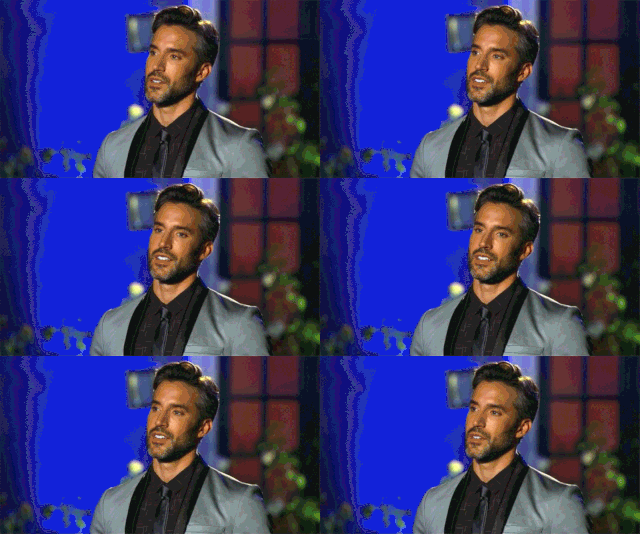
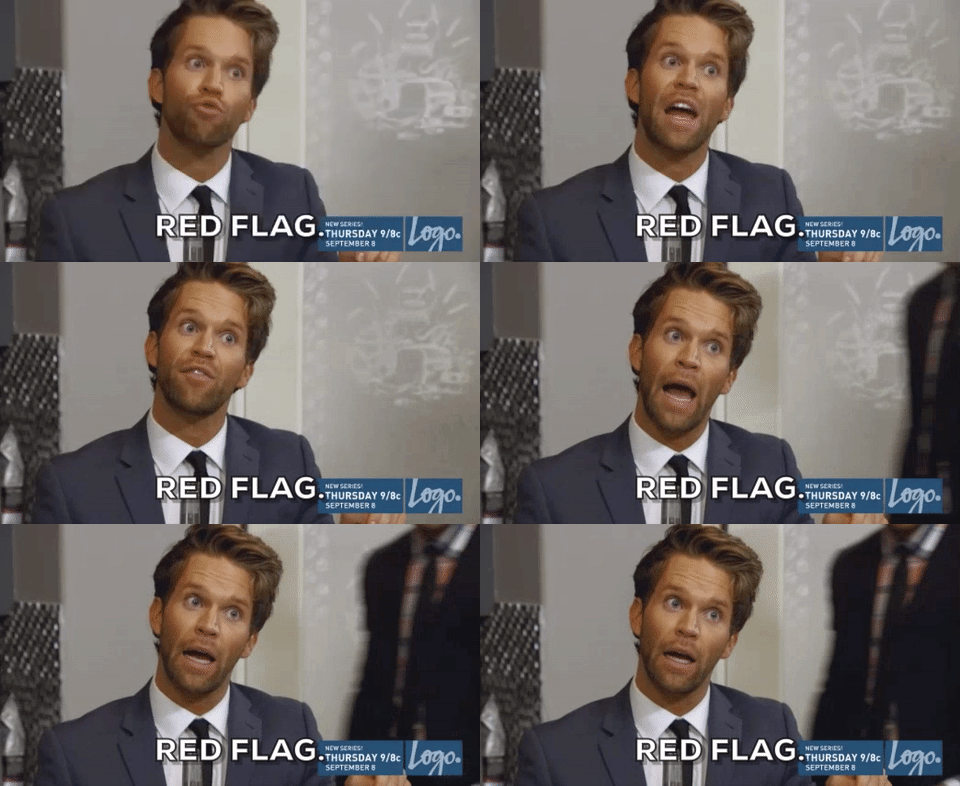
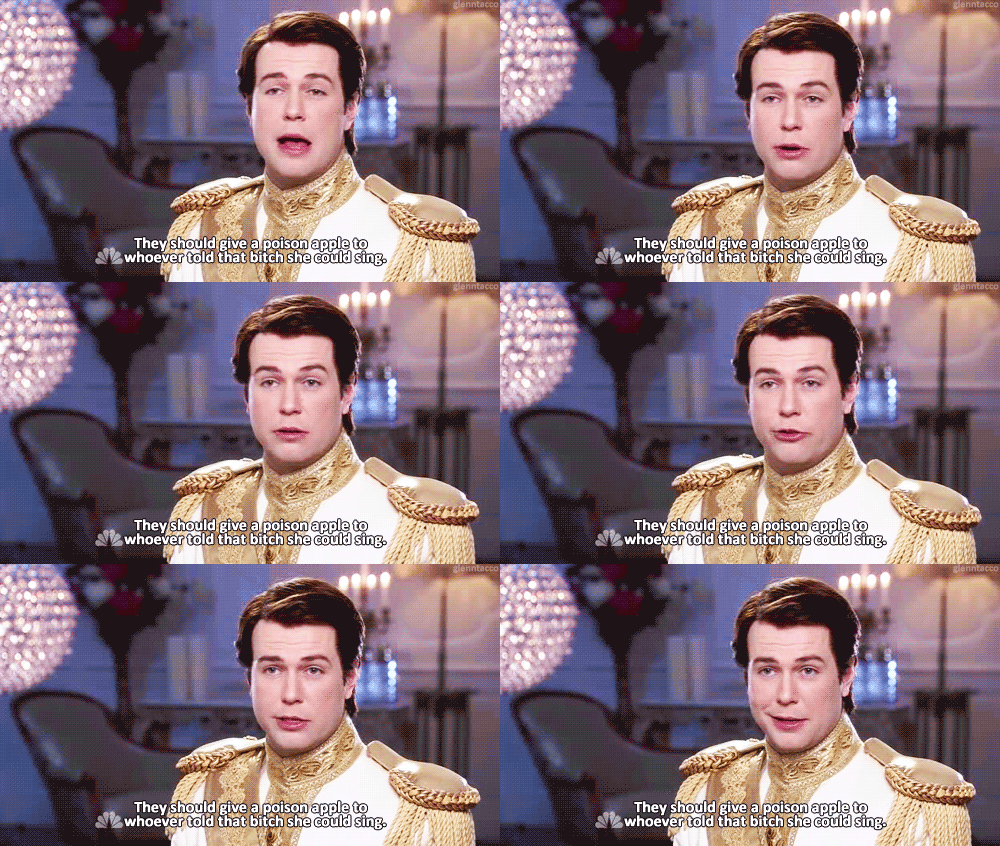
Review, television

REVIEW of RIVERDALE EP. 3, “Body Double”

Grade: A

The second episode of any series typically has a dip. The first episode sets up all the drama, and the second episode catches people up and fills in background. So the third episode of Riverdale, with the background of episode two’s “A Touch of Evil,” is able to forage onto new ground.

Betty resurrects the school newspaper because, when in doubt and your idyllic town has recently had a horrific murder, high school journalism is the answer. But given the fact that Betty’s mother, Alice Cooper, runs the Riverdale Register and printed all the leaked details of Jason’s autopsy and a front-page story with the headline “Cheryl: Guilty as Sin,” maybe some new journalism is healthy.

Like I predicted last week—Cheryl didn’t kill Jason. She’s “guilty” of lying to the police—aren’t we all?—and says that Jason wanted to get out of Riverdale so the twins faked his death. They heard the gunshot together in their summer whites and it wasn’t until Kevin found Jason’s body a week later that Cheryl realized Jason was dead. She tells Chief Keller about the gunshot—a fact which Archie laters corroborates when he comes clean (minus the fact that he’s in a statutory rape situation with Ms. Grundy; so “kinda clean”).

screen-shot-2017-02-10-at-5-04-13-pm

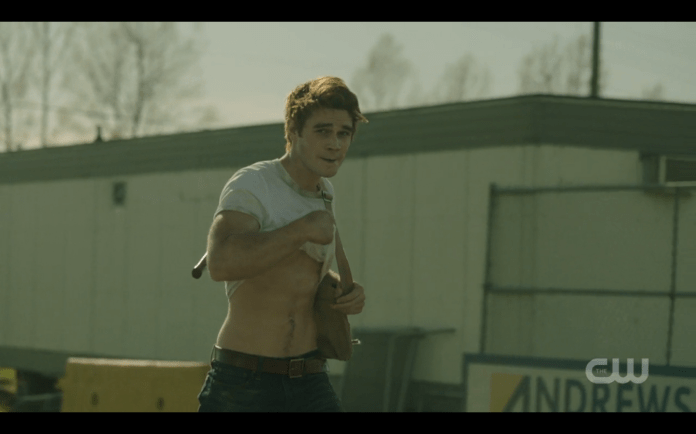
Source: The CW//Pointless, gratuitous shot of Archie, included because I am part of the problem.

The autopsy proved that Jason died July 11, and his body showed signs of freezer-burn, rope ties and—probably—torture. I mean, he ended up getting shot in the face, so I feel like it’s not out of line to assume that he was at least tortured before his untimely demise. So if Cheryl and Jason heard the gunshot together, then it was unconnected to them—at this point at least.

We are re-introduced to Dilton Doiley, the scout leader who found a soaked—chic—Cheryl on the side of the river. Through the magic of Jughead’s manipulation and sloppy stealing of a sundae, one of Dilton’s scouts reveals that Dilton shot the gun (and I guess he’ll lose his scout-ness if that came to light). So if Dilton shot the gun, and Jason escaped—we lose all sense of the timeline and any leads. Intrigue. Interestingly, the murder, and Archie, are kind of the B-plot this episode, with the juicy meat going to Betty and Veronica tackling slut-shaming. Essentially, Archie is grounded, Ms. Grundy calls off their lessons, and Archie turns to Josie for some music help.

Three episodes in, and Riverdale is slowly unveiling their people of color. The mayor is Josie’s mom; the all-star football guy is black; Dilton is played by an actor of Asian descent. And when Archie stops in on the Pussycats’ practice, Josie gives him a lesson in race relations. He can’t write in their voice because they are “divas of color.” And while things are changing in Riverdale, they’re not changing that fast.

screen-shot-2017-02-10-at-5-07-37-pm

Source: The CW// Chuck Clayton, who is hot, but mean

“We have to claw our way into the same rooms that you can just waltz into,” says Josie to Archie, who—to his credit—seems willing to admit that. Yay for some semblance of Riverdale becoming more woke. That, combined with the slut-shaming, makes this the most political and issue-driven episode yet, and I’m here for it. I’m not here for Cheryl kind of slut-shaming the girls, but I think that’s less of Cheryl being a slut-shamer and more of her just being sort of a dick.

Veronica goes on a date with Chuck Clayton, the all-star son of the football coach. Later he spreads a vicious rumor around school about her, and labels her a “Sticky Maple.” What a Sticky Maple is, they never actually get around to. So Riverdale, tho.
After finding out that A) this has happened to multiple girls before and B) there’s some sort of tallying playbook that the football team has, Veronica goes full-scorched earth. This episode reinforces the tropes of the traditional Archie comics—something they’ve been subverting so far. Veronica is the bad-ass, dark-sided one, and Betty is just trying to seek justice for these women.

#JusticeForEthel

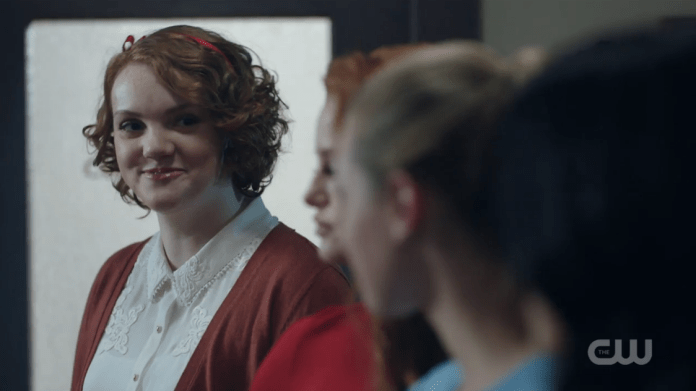
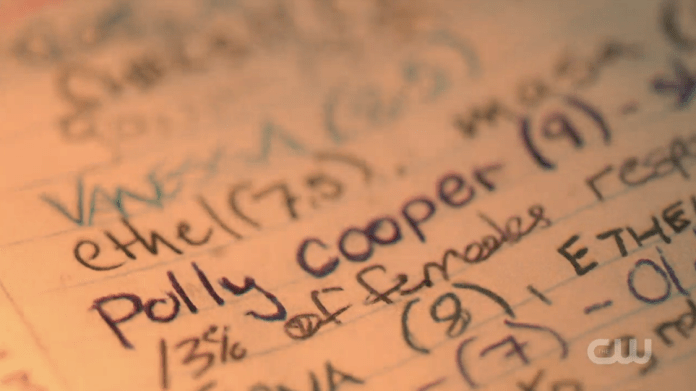
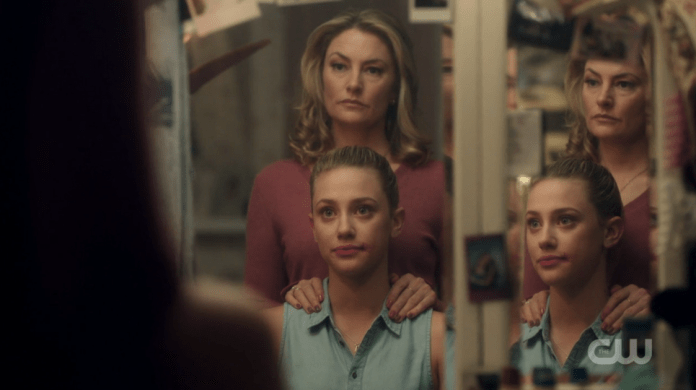
The gang—Kevin (who started out the season with a bang (almost literally) but has kind of faded into the background for me), Veronica (in the cape), Betty, Barb from Stranger Things, and Cheryl (in thigh-highs)—sneak into school with annoyingly bright flashlights and find the burn book. In a twist, Polly—the insane sister of Betty—is in the book with Jason Blossom. Betty, in an Una Thurman Pulp Fiction black wig, and Veronica lure Chuck the fuck to a second location with the promise of a hot tub, get him liquored up and handcuff him into the hot tub before starting to record. He admits that he made up the rumor, and it seems like “Okay, that’s it.”
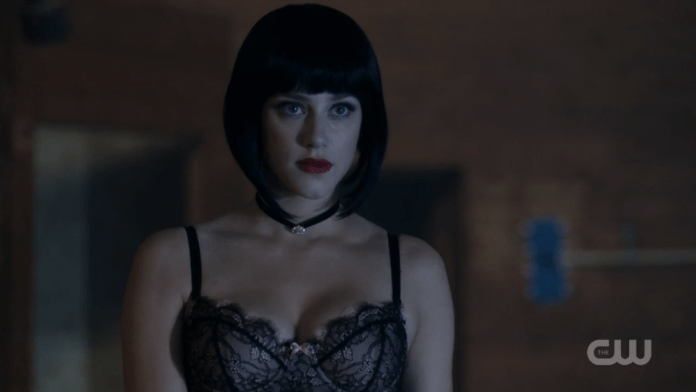
But it’s not it for Betty. Ever since she saw Polly’s name in the book, the mad glint has been back in her eyes. She turns up the heat, uses a high-heeled pump on Chuck’s head to waterboard him, and demands justice for Polly. But the thing is—in that moment, she is Polly, and she’s talking to Jason. It is, as Veronica later worriedly points out, very “Dr. Jekyll, Mistress Hyde.” Betty was almost normal the entire episode but this opens up a whole new book of questions. Is she having dissociative breaks? Who is Polly?

I can’t shake the feeling that Betty and Polly are linked to Jason’s disappearance and murder. And even though Betty later brushed off her little incident, the black wig is stashed in her locker—Polly is there, somewhere.
In the end, Dilton begs Betty and Jughead not to reveal that he’s the one to shoot the gun and offers up something in exchange: he saw Ms. Grundy’s car on the banks of the river, the tidbit that Archie purposefully left out. And as the closing scene—Archie and Ms. Grundy making out IN THE BAND ROOM OF THE HIGH SCHOOL—and the promo for next week indicate, we’re soon going to learn a lot more about who Ms. Grundy is.
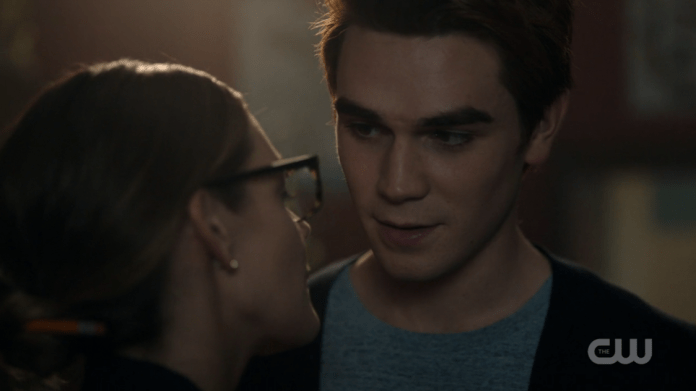
And more importantly, who Ms. Grundy isn’t.


STRAY OBSERVATIONS

  • Is this the town in fucking Footloose? This town has seen a murder and Archie’s dad is demonizing him for “writing songs”?
  • Veronica’s date characterizes her as a “former It-girl from New York”—is the only TV in this town “Gossip Girl?” Why are they all making the same references?
  • I love how Kevin Keller exists in a permanent state of surprise:
    • “You’re going on a date with the son of the football coach?!”
    • “Where did you get those thigh-high boots?!”
  • “I will cut the brakes on his souped-up phallic machine”—VERONICA IS GOING SCORCHED EARTH
  • CHUCK STOP LICKING YOUR LIPS
  • Theory: Cheryl is into Archie because he kinda looks like Jason
  • “Frida Shallow”
  • There’s the recurring motif of smudged, almost bloody red lipstick on Betty. Am I the only one noticing this?
  • MRS. COOPER GETS HIT IN THE FACE BY CHERYL’S MOM
#JusticeForEthel

Standard
Review, television

REVIEW of RIVERDALE EP. 2, “A Touch of Evil”

Grade: B+ for questions answered but also questions left unanswered.

Did I mention that until I was eight years old, I lived in a town called “Riverdale?” So maybe that’s why this episode of Riverdale struck so true with me. Because when my best friend, who’s just confessed her love for me, won’t answer my texts about a mysterious town murder, I also run shirtless to the house of the teacher I’m having an affair with. So spooky how similar I am to Archie!

The revelation that Jason Blossom’s death was due to him being shot in the face rather than drowning shakes the foundation of misty Riverdale. Seriously, there is some serious dust in the air in Riverdale High and I can’t help but worry for the kids with asthma. Are provisions being made for them?

Archie is racked with guilt over the knowledge he possesses. He knows that whoever shot Jason did it early in the morning on the Fourth of July. But he can’t open up to anybody because he only knows this because he was entwined in the arms of music teacher Ms. Grundy. Let us remember that Archie—despite his oiled, muscled body and jawline that protrudes out of the screen—is supposedly a high school sophomore.

The “living mannequin” twins ask Cheryl during science class (Algebra? Chemistry? Physics?) the very question I was wondering myself: Is Cheryl lying? Cheryl told the police that Jason fell into the water to get the gossamer-cloth white glove she had dropped. Later we find out that Jason was shot.

But more comes out—with a proctologist’s snap of her rubber glove, Cheryl reveals that they both fell into the river. Cheryl made it to shore—alone. But can we believe her? Something seems off with this blossom.

The school organizes a pep rally to honor Jason because why not, and Betty uses Veronica’s “I’m sorry” mani-pedi with Cheryl as a mani-petty.

And more comes out of the falling-out between Jughead and Archie. They were meant to go on a road trip (do either of them possibly have licenses?) on the Fourth of July, but Archie canceled and the entire summer was weird after that. Later, Jughead witnesses Archie and Ms. Grundy canoodling BECAUSE THEY’RE NOT CAREFUL AT ALL and confronts Archie. It seems like Ms. Grundy might be this episode’s titular “touch of evil.”

Archie, torn with guilt and also just shredded, wants to tell the truth about the Fourth of July. Ms. Grundy holds Archie in the palm of her hand and says no, claiming that she has feelings for him and this would ruin what they “have.” What they “have,” Ms. Grundy, is a jailable offense, you freak. Ms. Grundy is officially on my shit list. She’s emotionally manipulating Archie into not telling that creepy Principal Weatherbee about them because she doesn’t want to go to prison for child molestation.

While Cheryl straddles Petty Betty to do her makeup, she asks a lot of questions about Polly, Betty’s sister who went insane and now lives in a group home. Yikes. Yikes. Things escalate (not sexually) and Cheryl accuses Polly of killing Jason. But in that moment, there’s something cracked in Betty. Something raw. You can see it in her face as she rises up against Cheryl, and something dark blacks out her eyes.

New Theory: Polly, the unseen sister, is the secret half-sibling of Cheryl and Jason. Think about it—without reason, Mrs. Cooper is so against Polly and Jason. And there’s something incestuous about Cheryl and Jason—sipping out of the same milkshake, wearing coordinated outfits. Could it that sibling love runs deep in the river of relatives? Cheryl and Jason, and Jason and Polly?

In a fun little aside, we see Betty’s mom (Mom Cooper) bribing the coroner to get the straight truth-tea of Jason’s autopsy. “Marbling of the veins, signs of scavenger activity, ligature marks on both wrists, and a hint of cryo-necrotic preservation.” I don’t know what any of that means but I’m pretty sure that—plus the whole “bullet to the face” thing—means that Jason didn’t die of natural causes.

At the pep rally, which was always a horrible idea, Cheryl is overcome with memories of Jason. She sprints away and Veronica comforts her, Petty hovering just beyond the doorway.

“Jason, he was supposed to come back,” said Cheryl, sobbing in the locker room. Veronica mouths the words. 

Come back.

And suddenly, Cheryl’s anger at Betty makes more sense. “I think your crazy, tweaked-out sister killed him.” Was Jason going to meet Polly? Was Cheryl covering for him?

And did Jason actually meet Polly in the woods? Or was someone else waiting for him there? Someone with a motive to kill him, maybe someone whose sister was driven insane by a relationship with Jason?

Did Betty kill Jason?

But before we can get an answer to that: we get an answer to last week’s burning question—Who gets arrested?

The answer, kind of surprisingly, is Cheryl. But also not that surprisingly because she was the last person to see him alive and she already fudged the details of what had happened. But her willingness to accept that she’s been arrested (but never came forward) proves that she believes herself to be responsible for Jason’s death. Whether she actually caused it, I don’t believe to be the case. But her twintuition means double the guilt.

OBSERVATIONS AND QUESTIONS FOR NEXT EPISODE:

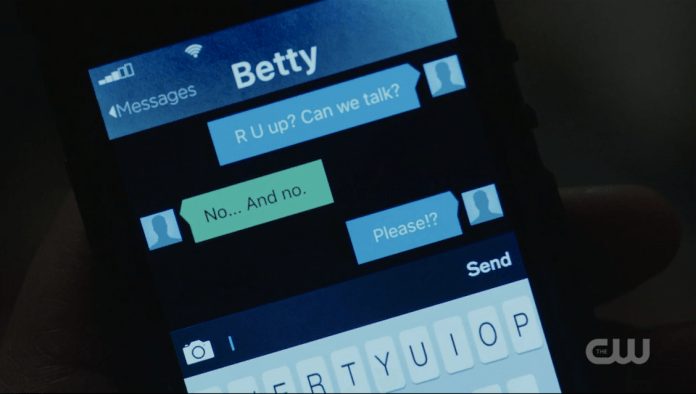
  • If both Betty and Archie have iPhones, then WHY ARE THEY USING SOME WEIRD SMS SYSTEM? THIS INFURIATES ME.
  • Archie’s sweaty, shirtless body flipping around in bed=peak.
  • What alternate universe is this where a sophomore in high school can leave the house in the dead of night and all his parental guardian says is, “Where’d you sneak off to last night?” If I did that as a sophomore in high school, or NOW, I wouldn’t have legs the next day.
  • Btw, the fact that he calls her “Ms. Grundy” instead of her first name (“Pamela” I’m presuming, or something else terrible) proves that HE SHOULD NOT BE WITH HER.
  • “Watch it, Wednesday Addams,” is my favorite new diss.
  • Only Cheryl Blossom could end her threat that her brother’s killer will end up in the electric chair with a hashtag. #RiverdaleStrong
  • “I am devastatingly handsome in that classic pre-accident Montgomery Clift kind of way,” says Kevin Keller, and so say we all.
  • What is that “Max Where the Wild Things Are” beanie that Jughead is wearing?!
  • “Let’s honor the memory of our murdered classmate, Jason Blossom, with a pep rally and a sexy cover of “Sugar, Honey, Honey” by Josie and the Pussycats!”
  • Also the song “Sugar, Honey, Honey” is by the band, The Archies. Very spooky.
  • “Butt out, closet monster, you have forfeited the right to take the higher road,” Cheryl
  • We also learn that Moose, the sexually fluid guy who wanted to have sex on a riverbank, has an official girlfriend named “Midge.” That is such a “beard” name.
  • Also I would like to say that I used a locker room all throughout high school and was never hit on by a football player named Moose. I would find this more insulting had I not looked like a thumb in high school.
Standard
Review, television

REVIEW of RIVERDALE EP. 1, “The River’s Edge”

Grade: A-/B+

I’ve never really been a fan of the Archie comics. I mean, I’ve been aware of them in the way that you’re aware of everything tangentially that existed in your life. But I was always more of a Calvin and Hobbes kid. I was made aware of the newest adaption from the podcast Who? Weekly. But I think the premise—comic remade into sexy murder-y thriller—would’ve been enough to eventually put it on my radar.

The cinematography is clean, lush and hazy. It’s filmed in Vancouver, so it has that “better than any forest, any town, any place you’ve ever been” combination of familiarity and dissidence.

Let’s start with the light stuff. This is the CW, so we’re expecting certain tropes. And we’re gifted them. There’s the Gay Best Friend who’s proves that somehow gay people are just cloning each other because I swear if I’ve seen one attractive gay with a severely-gelled hairstyle I’ve seen a thousand.

“Is being a cheerleader still a thing?” asks Kevin Keller (the gay).

“Is being the gay best friend still a thing?” responds Cheryl Blossom (the ginger).

And there’s the “sexy” lesbian kiss between Veronica and Betty to give their cheerleading audition some “sizzle.” But rather than bask in the awkward and trite sexuality, they call to the moment.

“Check your sell-by date ladies, faux-lesbian kissing hasn’t been taboo since 1994.” YES CHERYL YES.

I think what I like most is that they’re—at this point—subverting expectations. I can handle the hypersexualized clichés but as long as we’re recognizing them for what they are. And I can handle classic tropes as long as we classifying them in their proper sphere: fucking science fiction. Because no sophomore in high school looks like Archie Andrews. And that’s fine, but we need to remember our place.

Side bar: It’s nice to see depictions of hot redheads on screen. We are a group that are largely unrepresented.

Also I’m tired of jocks wanting to play music and their dads being against it. this is 2017—Donald Trump is president—you don’t need any qualifications to do anything anymore. And of course, because Riverdale is trying to show us it’s woke, Veronica points out much the same thing. “Guys, can’t we just liberate ourselves from the tired dichotomy of “jock” “artist?” Can’t we, in this post-James Franco world, just be all things at once?”

I never watched Pretty Little Liars but I assume it’s a similar thing, how can students and teachers who are fucking yell about their illicit affairs in public places and nobody say, “Whowhatnow?” It seems physically impossible that no one immediately discovers their affair because they’re literally screaming about it.

Aside from Reggie and Josie and the Pussycats,* Riverdale seems entirely full of people so white they’re nearly translucent. You can almost hear the thoughts echoing in Josie’s head as she looks out onto the crowd of students dancing to the song she’s singing (that’s a cover of the song that the Blossom twins were conceived to), “Why am I here with these idiots?” Like I get this is the CW, but if you’re gonna be woke about the Gay Best Friend, you’ve gotta be woke about everything else too.

Now on to the eeriness. The pop culture references are a little uneasy, at odds with Veronica’s sweater set and the malt shop. But maybe that’s the point? The bizarreness of this place existing both in the ‘50s and in 2017—making references to Blue Jasmine, Mad Men, and Ansel Elgort—mimics the bizarreness of Riverdale. You don’t expect people who live like this to know references like that. It begs more questions: do they use Spotify? Why were the Blossom twins in a Thunderbird? WHY is Veronica wearing a sweater-set and pearls? You’re put off-kilter by the “hereness” and “otherness” of the town. Things are off-kilter here.

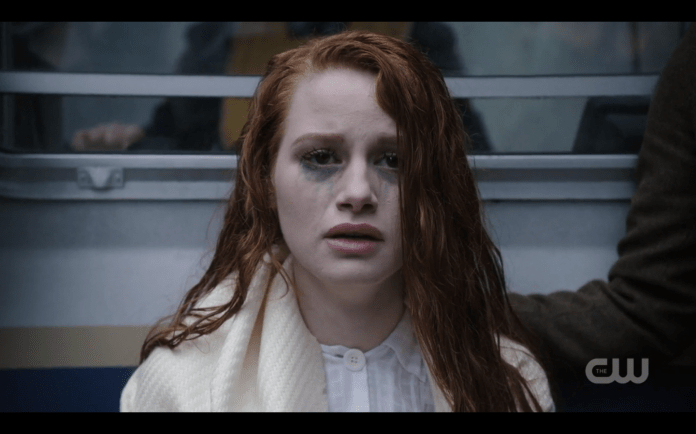
The classic cinematography showcases beautifully the ice-white face of Cheryl Blossom against the blackness of her smudged mascara and her red hair. The sharply angled eyebrows of Veronica Lodge. The red lipstick from Veronica’s kiss running across Betty’s lips like a nosebleed and the red gashes on her palms from her tightly clenched fists. There’s a gruesomeness in Riverdale.

But the scenes and the music are tinny and Instagrammy—we’re experiencing through a filter. It’s like we’re someone watching the world unfold in front of them, someone beyond the average viewer. It’s a sentiment made stronger by the fact that we’re brought into the world of Riverdale by the voice of Jughead.

And it’s echoed by the song (“The Passenger” by Hunter as a Horse) rising above Jason Blossom’s waterlogged corpse as it’s carried to the ambulance in a stark yellow body bag.

Someone is watchingsomeone is watching.”

But who?

QUESTIONS FOR NEXT EPISODE:

  • Who shot Jason Blossom?
  • Did someone drag Jason Blossom’s body from the depths of the river?
  • Where did Ms. Grundy get her heart-shaped sunglasses?
  • What is “pouring concrete?”
  • Is Jughead our Dan Humphrey?
  • Does anyone remember The Secret Circle, which was also on the CW? If so, let’s talk.
  • Who is getting arrested for the murder of Jason Blossom halfway through fifth period on Tuesday?

*Edit: it has come to my attention that KJ Apa, the actor who portrays Archie Andrews, is part-Samoan.

screen-shot-2017-01-27-at-4-31-59-pm

Source: CW//How extra

Standard
Review, television

Gilmore Girls: A Year in the Life—A Revival or a Resurrection?

What is the purpose of a revival?

by Danny McCarthy


Revivals typically come to accomplish one of two things: give the fans what they want, or advance the story.

Some shows debuted before their time and were granted revivals as a second chance. HBO’s The Comeback with Lisa Kudrow debuted in 2005. It was filmed in the style of reality television, a cousin to mockumentary. The Comeback focused on Kudrow’s Valerie Cherish, a former sitcom It girl trying to make her “comeback” through a reality television series. But whereas shows like The Office, Parks & Recreation, and Arrested Development succeeded, The Comeback fell flat. Maybe it’s because widespread reality television like The Real Housewives franchise wouldn’t begin until 2006. That franchise focused on adult women finding the balance, badly, between anonymity and celebrity. But when The Comeback aired, the world didn’t have the context or appreciation of a middle-aged woman clutching at fame with gel nails.

But once the proper context was developed, The Comeback became a cult classic. It was revived nine years later and its second season aired in 2014. Gilmore Girls, first airing in 2000 and finishing its seventh season in 2007, was gone for almost a decade before Netflix revived it. In that time, it had become an archetype of television, fast-paced witticisms and dramedies.

We sailed through six seasons of glorious, witty banter, and one season of tortured agony. The showrunners and creators of Gilmore Girls, Amy Sherman-Palladino and her husband Daniel Palladino, left after the sixth season due to contract disputes, and it showed. It was the prequel to American Horror Story: Murder House, where everything looks the same, but is terrible and, surprise, they’re all ghosts! So when the first hint of a comeback came, first in the possibility of a movie and then through Netflix, it felt like redemption.

Instead, it was horrible.

Gilmore Girls originally aired before social media had taken off, before audiences were divided up into teams favoring one love interest or another, “shipping” or fandoms. But its quickness and humor and heart kept it popular until it became ingrained in television culture. The show was included in TIME’s “All-TIME 100 TV Shows” and Entertainment Weekly’s “100 Greatest Movies, TV Shows, and More.”

Despite the dated references, Gilmore Girls succeeded because of the humor and the story. A mother who got pregnant at 16, and her 16-year-old daughter. A close-knit, quirky small town. Socioeconomic stratification and the pressures of society life. Complex inter-dynamics between mothers and daughters, fathers and daughters. It succeeded because at any age, family remained timeless.

The show became public domain in the way that cult classics become public domain. People grow up with it, but the real attachment bonding comes after the show ends. The reruns, the deep settling in and rote memorization of lines—everything about the show becomes well-worn and memories of the audience become ingrained in the show’s fiber. Gilmore Girls became a “more than” situation: more than a TV show, more than a comedy, etc. And the “more than” and attachment bonding created both fierce possession and hungry longing. “We want the show to come back, but we never want it to be touched.”

So in a way, the Gilmore Girls revival was always doomed. No matter what it did, it would never fulfill the wishes of a decade of longing. It would never, could never satisfy voracious fans.

The revival could’ve gone into either wish fulfillment or plot. Wish fulfillment would’ve put it into the category of the Sex and the City movies. Rotten Tomatoes gave the first movie revival a score of 49%. But the movie was never about creating great content. It was getting those four women back together, having Carrie proselytize, Samantha fuck some strangers, Charlotte be outraged, and Miranda be redheaded. And they did it. And they did it again for Sex and the City 2, except they Abu Dhabi-ed it.

Driven by plot would’ve been something akin to The Comeback—a story to tell and something to prove. But the revival—four 90-minute mini-movies under the overarching title A Year in the Life—somehow managed to accomplish neither of these options. It avoided wish fulfillment and didn’t have enough plot to satisfy one 90-minute movie, let alone four.

Ten years after the seventh season finale, Rory is 32. It’s serendipitously coincidental, because Lorelai was 32 at the beginning of the original series. That sense of “full circle” pervades the entire revival. Lorelai was 32 at the beginning of the beginning, Rory is 32 at the beginning of the end. It begins with death—that of the family patriarch, Richard—and ends with life—Rory’s surprise pregnancy. The sense of cycle feels comforting superficially as the banter of the girls and the warmth of Stars Hollow opens up in the first chapter, “Winter.” No one does winter quite like the Gilmore Girls. But after the initial nostalgia high fades away, the high-definition reveals something that was never apparent in the blurred glow of the original run.

Cracks.

Lines in the faces of the actors. A squeaky-clean, sitcom-like feeling to the kitchen. Everything feels Squeegeed, like the Lifetime Original adaption of Gilmore Girls. And once the initial banter dies down, the characters feel uncomfortable. Their deep appreciation for counterculture has become snobbish hipsterdom. They can’t figure out WiFi; they deride Tweets. Granted, their run was in the time of flip-phones, but Rory became an adult in the iPhone age. She knows how to Tweet. She might even know how to Snapchat.

Everything that was charming—references to The Go-Go’s, the Brady Bunch family, Brad and Jen—has curdled into general misanthropy. Lorelai and Rory seem stuck in the past, almost as if they were forcibly ripped into the future against their wills.

The format seemed to encourage lethargic timelines. Instead of 45 minutes, the showrunners played with 90. However, the general plot morsels seem to be the same, and moments that would be fun and fleeting become prolonged—there’s 10 minutes dedicated to watching a Stars Hollow musical in the theme of Hamilton. Just watching; not even intercut with anything else. Sherman-Palladino didn’t know what to do with the luxury of more time.

When Amy and her husband left the series, she mentioned that there were four words that she had known since the beginning would be how she ended the show. However, they left before its ending and the last four words remained a mystery. She never divulged them in case someday, somehow, the show came back. If there are going to be more seasons in the revival, the showrunners have not yet let on. And if anything were to confirm the opposite, it would be the use of the Last Four Words.

The three storylines—Emily (Lorelai’s mother), Lorelai, and Rory—seemed to have been decided importance in descending order. Emily, a widow after fifty years of marriage, unravels in a posh society that does not abide unraveling. Lorelai, after twists and turns in her relationship with the diner-owner Luke and the ultimate achieval of owning a successful inn, is unfulfilled but doesn’t know why. And Rory, the original ingénue, is resting on wilted laurels from a piece in the New Yorker.

Rory’s was particularly painful to watch. At 32, she’s more unmoored than in the original run. She’s not a very good journalist; she can’t land a book deal. The hits started early, and kept on coming. And throughout it all, you don’t even feel that bad for her, because she doesn’t seem to be trying very hard to change it.

She’s snarky about the woman she’s profiling for the book. She walks into a job interview without a single pitch. On assignment for GQ on the mentality behind people waiting hours in line, she literally walks past a long line at the head of which is just two guys eating a sandwich. Rather than utilizing that—which perfectly exemplifies line culture—she keeps walking. Opportunities, or opportunities at opportunities, seem to be throwing themselves at her, and nothing sticks.

Emily received the richest narrative. Throughout the entire run, her grief is palpable as she redecorates her house, tries mother-daughter therapy with Lorelai, tries to start a business franchise with Luke. And in the end, she curses out her society girlfriends at a function and realizes that the life she’s so desperately trying to fit back together died with her husband Richard. The world of a society wife is not the world of a society widow. So she picks up everything, moves to Nantucket and starts working as a docent at a museum. It’s odd, but it fits.

Lorelai’s storyline was not as satisfying or nuanced, but it still works. Her business partner has up and left, and she’s struggling to figure out how to take her inn to the next level. In the end, a lot of her unhappiness is wrapped up in the fraught relationship with her mother. A failed attempt to go on a Reese Witherspoon’s Wild-worthy adventure ends with actual self-realization with Emily. And after that fog clears up, she asks Luke to marry her, and she looks at properties to expand her business.

As for Rory, things couldn’t pan out because they had never been fully fleshed. Her storylines felt like a series of failed pitches. She’s working on a book with a British author—that falls through. She’s hounded by the wunderkind CEO of an online media site, but when she goes in for an interview expecting a job offer, she’s sorely disappointed. Her attempts at pitching for GQ fail. In the end, she conceives the idea of writing a book about her and Lorelai. It has all the desperation of Valerie Cherish and the ladies of Real Housewives.

This is her “last shot.” But is it? She received a job offer to work at her old high school. She’s still relatively young. She’s Yale-educated. How can writing one book—set aside the reality and rigors of getting something published—be the answer to all of her prayers? A 32-year-old’s last result should not be writing a memoir. She would’ve died on the streets in her 20s if she was so unprepared for life.

So at the end of “Fall,” the last of the four episodes, Rory and Lorelai are sitting on the steps of the town gazebo after Lorelai’s long-awaited wedding. Rory is still lost, but plans to write a book about her and her mother (annoyingly titled Gilmore Girls). She’s ended things with Logan, her one-time college boyfriend, with whom she’s had an on-again/off-again friends-with-benefits situation for the entire revival.

Lorelai muses about being a married lady and doing “married-lady things.” Rory’s hands strangle each other in her lap.

“Hey, what’s going on in there?” Lorelai asks, putting a hand on Rory’s leg. Rory’s eyes—vivid blue and one of the eerie similarities she shared with her mother Lorelai—are swimming with tears.

“I want to remember it all, every detail,” Rory answers. The camera flips to the back of them, watching them as they watch the town.

“Mom?”

“Yeah?”

“I’m pregnant.”

CUT TO BLACK. END OF SERIES.

There’s so much left unsaid that at the arrival of the last four words, they don’t ring of series-ending closure. Instead it seems like, somehow, she’s more unprepared than her mother, who had a child at 16, got a job and a degree.

The stories felt unfulfilled in the end. We had no reasoning for Rory’s intense ennui, or Lorelai’s moodiness. They were dredged down. They were weighty. So when the last four words arrived, the question was not, “What happens next?” but “What the fuck was that?”

Even the filming of the final words resists closure. Rather than tacit resolution, perhaps Lorelai grabbing Rory’s hand in comfort and solidarity, or a steady panning out over the town they love—it cuts to black. It’s jarring and more resembles the cliffhanger at the end of a season than a tantalizing peek into future at a series’ end.

The Gilmore Girls revival resisted spoon-feeding the fans what they wanted. It could’ve gone the easy route, made the easy laughs and ended the entire thing with a flourish of guitar music. Instead, it tried to tackle uncomfortable subjects like the death of a parent, or the fallout from a fizzled-out career. But instead of tackling them full on, the show cantered over and hastily wrapped them up with a bow and some emotional music.

I could see where the revival wanted to go. It had a bigger budget, a more cinematic scope, and it wanted to have issues that measured up. But they fell flat and, combined with the overhype, gutted the series of success. Superficially, Gilmore Girls: A Year in the Life does what it says. It brings us the Gilmore girls, and takes us through a year in their life. Some years just suck.

Standard
pop culture, Review, television

Review: WESTWORLD SEASON FINALE: PREDICTIONS ASKED AND ANSWERED

Grade: A for Entertainment, C for Answering Basic Human Questions, D for the fact that it’s not coming back until 2018

If you’ve hung out with me at all in the last few weeks (highly unlikely, as I am a very popular person who spends almost all of his time in bed watching Netflix) you might’ve/probably heard me mention the HBO sci-fi Western Westworld. I’ve been obsessed.

It’s been a while since I’ve been obsessed with a show—the last one was probably Scandal where I fully binged—but it’s been even longer since I’ve been obsessed with a show that’s airing in real time. Sure, at any given point I’m watching at least four different Bravo shows, but that’s less of an obsession and more watching of a real-time science experiment unfold. So the experience of watching a show week-to-week, and ruminating over it and dissecting it and reading about it, is something that I haven’t engaged in for a long time.

The finale of Westworld’s first season is this Sunday (I’m writing this on Saturday), so I think it would be a fun little experiment to write down some of my predictions and theories today (Saturday), watch the show tomorrow (Sunday) and then do a review-cum-recap-discussion for Monday. Sound sexy? LET’S GO. Also, obviously spoilers (SPOILERS) ahead. I have, like, four readers in total, and only one of them watches Westworld and I know she’s up-to-date, so I’m not worried. But don’t come for me.

QUESTIONS/PREDICTIONS:

1). Why did Dolores kill Arnold?

My running theory is that Ford programmed Dolores to kill Arnold. I think this BECAUSE Ford later essentially SPOILER rebuilt Arnold (i.e. Bernard) as the perfect companion—someone who was his “partner” but whom he inevitably controlled. Arnold and Ford had fundamentally different ideas for the park. It seems as if Arnold wanted to see if he could create sentience, and if he did, to set those sentient hosts free. Ford seems undoubtedly more power-hungry and likes being a god in the park, able to control everything. He doesn’t want his subjects to leave. I think Ford had Arnold killed and rebirthed him in a mode he could control. The minutiae of Bernard’s movements, such as the way he cleaned his glasses, leads us to believe that Ford is searching for some semblance of his partner. He wants a version of Arnold.

2). Maeve will die. Like, for good this time.

I DON’T WANT THIS TO BE TRUE, BUT I THINK IT IS. Stay with me. Westworld has been renewed for a second season. Thus, we have to assume that the greater plot of androids gaining sentience and causing ruckus in the park will keep getting bigger and bigger. Maeve is already rapidly—or has even already gained—sentience, and she’s building an army. The Westworld creators have enough story for five seasons, and it’s reasonable to assume that Maeve’s storyline—or something similar—is along that arc. However, if Maeve is already there, then where else can she go without being A) killed or B) lobotomized and shuffled back to square one. I love Maeve and I love Thandie Newton’s portrayal of her, so I desperately hope I’m wrong. But I feel like she’s too advanced for them to keep her around if they want to keep the show on for multiple seasons, so they got our hopes up to dash them.

3). MiB is William, who saw Dolores go through the Maze (reach sentience) and thought that the maze was for everyone and would reach total enlightenment.

Can someone tell me exactly what the Maze is? I saw on a Reddit thread people being like “Duh obviously the Maze is just a metaphor and not a real place” and I was like “oH, ha HA who wuld think that not me obvi not me” back when I totally did and thought that an android-ed version of Arnold was in the center. Now I think it refers to the process of an android gaining sentience. So my theory is that the MiB is William, who followed Dolores on her “Mazing” and becoming sentient. However, he got it completely wrong and thought the Maze applied to everyone, when it just applies to hosts. So when his wife dies and his daughter hates him, he’s looking for meaning, so he remembers the Maze. He thinks to himself, “I’ll find life’s meaning that way!” But the Maze isn’t for him.

4). What will happen to Stubbs and Elsie?

Possibly the worst names, but that’s beside the point. I don’t believe that Elsie is dead until I see her cold rigor-mortised corpse on an examining table. And it can’t be a coincidence that they were both taken by unregistered hosts. Maybe Ford is reworking them to be models for other hosts? I don’t think that they’re dead, but maybe they’re not quite alive either…

5). Someone else will be revealed as a host.

This I kinda hope doesn’t happen, because overusing that trick—like how The Vampire Diaries kept bringing people back from the dead so by the eightieth time you didn’t even blink when a favorite character died—will rapidly grow old. But I think that that would be a good twist if it was someone HUGE we didn’t expect. Who it would be, I have no idea.

NOW I’M GONNA STOP WRITING UNTIL IT AIRS AND I CAN COMMENT. OH BOY. SOUNDS LIKE FUN.

(watches it)

WOWWOWOWOWW.

1). Dolores killed Arnold because Arnold asked her to.

WOWWOW. Arnold wanted to cripple Westworld into not opening, so he had Dolores kill everybody. Wait, I’m just realizing—He realizes that Dolores has sentience, so he has her kill everyone and then herself? Whatever, I can’t even get into that. Also Dolores was Wyatt all along, which I knew.

2). Maeve DOESN’T DIE.

Thank god(s). Maeve actually has probably my favorite storyline in the entire show, and Thandie Newton deserves an award for her incredible acting. The twist that her “sentience” was part of a program (possibly by Ford) and an “escape” narrative is heartbreaking, and definitely not a twist I was expecting. But her choice to get off the train (thereby undermining her narrative, which was to escape) and go back and search for her “daughter” proves that she is sentient.

3). MiB is William, and William is an asshole.

If you go on Reddit, this one was obvious. But it’s nice to be validated. Also I was SO right about MiB knowing jack shit about the Maze. And the fact that the ‘physical’ Maze ended up being a game reminds me of when Viserys from Game of Thrones wanted his “crown” so Khal Drogo poured molten gold over his head, killing him instantly. Nice memories. Also, William sucked even when he was nice, so it’s no surprise that he sucks when he’s mean, too.

4). Who the fuck knows.

 5). This didn’t happen either.

Although the twist that Ford’s last narrative was a robot rebellion is a nice little twist, and adds a lot more nuance to his character than just the decrepit old overlord god. Also whether he’s actually doing the revolution for the right reasons is yet to be seen. Also I suspect that the “Ford” that was killed was a host-Ford.

*****

The following is adapted from a frantic text I sent to myself while I was walking to the gym.

The gala massacre reminded me a lot of Cersei’s killing of everyone via wildfire (RIP Margaery). It’s the kind of shit that’s beautifully orchestrated, and the viewer gets the spine-tingling pleasure of realizing what’s about to happen right before it happens. Both Ford and Cersei would benefit from everyone opposing them being killed, so that’s exactly what they do. I will admit that the Game of Thrones sequence of that killing is one of my favorite television moments ever.

The gala killing closes the loop that began in the park’s nascence, and reinforces the idea of moving “upward” (towards higher living) through repetition. Change happens when you cycle through. The first loop was Arnold’s orchestration of the massacre for the liberation of the hosts. 35 years later, Ford makes the same loop. His loop contains the question of motive. I do believe that he wants the hosts to be out of the control of Delos, but you have to wonder if his actions were edged in retribution. He would never let anyone else have control over his creations.

Quick side bar—Was Charlotte Hale crying while Ford was giving his speech? And if so, why?

In a larger scheme, the gala massacre is the same methodology that Westworld utilized forever. When things get out of control, you wipe the slate clean. You start from the beginning by destroying everything. Creation out of chaos. That raises the concern of “Was that really the right thing to do?” If the hosts are utilizing the same methods that their oppressors have used, aren’t they just stuck in another loop, albeit from a different perspective?

Maeve’s story served largely as a red herring. You were so preoccupied with her rapid rise to sentience, as compared to Dolores’ relative stagnation that you forgot about Dolores when, at least in the eyes of the show, she was the one achieving true sentience. And the purposeful focus on Maeve makes the admission that her escape is a narrative becomes heartbreaking.

The question ringing through the entire season was, “How much pain are you willing to endure until things get better?” It’s how the hosts gain sentience; it’s their/our cornerstones. In fact, it’s only Maeve who’s really showed the power of pain. In the middle of the episode, Maeve asked Bernard to wipe her memories of her daughter. He refuses, as they operate as her cornerstone memory—the memory around which her entire personality was built—and as such would destroy her.

But it’s her memories of her daughter that end up taking her off the train and heading back into the park. It’s what causes her to override her narrative—to Escape—and it’s what marks, in the end, her sentience. Her pain and her love—entertwined—have evolved her into sentience.

In season two, Westworld will undoubtedly play with a wider scope. The brief foray into “Samurai World” and the fact that Maeve’s daughter is in Park 1 (out of how many?) means that there’s a much wider Delos beast. It leads to a lot of questions: Why was Delos so concerned with Westworld and getting their data? Are all the hosts creations of Ford, even the ones from different parks? Will we start the next season in a different World, and have to go through the same thing again? Is that the point of the show, that we go through the same loops over and over, until the small details build up and become something larger?

I fucking hope not.

See you in 2018, Westworld, when I’m a dead-eyed adult.

bye.

Standard
music, Review

THINKPIECE: LADY GAGA’S METHODOLOGY

There’s something oddly alien about the stripped-down façade of Lady Gaga in promotional shoots for her latest album Joanne. Without the elaborate wigs and geometric makeup, her architectural cheekbones sweep along her face like foreign objects. Her full lips and sharp nose have a heavy, hawkish feeling. It’s jarring, because everything we’ve known of Gaga was the theatrics. And we have to wonder: have we ever known what she actually looked like?

In comparison to her peers, Gaga’s motives in her musical choices have been inscrutable. It’s hard to predict what she’ll do next. This difficulty in analysis is in part due to how we analyze her. Her fans and critics take her discography as fact, as a timeline. We do this because that’s what’s always been done. As artists age, their albums reflect that.

We analyzed her like this because that’s the framework we’re given. It’s worked for other pop artists, like Beyoncé and Adele. It’s possible to track the change from I Am…Sasha Fierce to Lemonade as Beyoncé became more confident and solid in the duality of femininity and power. 25 makes cohesive sense when in collaboration with 21 as Adele grappled with her rapid rise to stardom.

But Gaga’s choices don’t make that same sort of sense. And if you use the sequential model to analyze her discography, her discography makes even less sense. Because she’s not like other artists. She doesn’t work sequentially, she works laterally.

For Joanne, Lady Gaga’s fifth studio album, she took an earthier, cigarette smoke-wreathed image. She’s wearing white t-shirts and mom jeans, her blonde hair pulled back tightly into a bun or capped underneath a wide-brimmed pink hat. The music shifts from rock to a country twang easily. It’s partially a reflection of the Americana genre, but Gaga feels more grounded in this album.

Joanne centers around the theme of familial ties. “Joanne” is Gaga’s real middle name, but it is also the name of her father’s deceased sister. And so while this is another experimentation on the part of Lady Gaga, the themes—more personal than on her previous albums—makes Joanne her most deeply revealing album yet.

The sound of Joanne was a direct response to 2013’s ARTPOP, her previous solo studio album. In the wake of ARTPOP’s, Gaga took a more stripped-down tone, relying on her powerful voice rather than theatrics. It’s evident in her 2014 jazz album Cheek to Cheek; it’s present in her performance of songs from The Sound of Music at the 2015 Oscars.

Gaga said that she was inspired and influenced by country music. But Joanne is not a country album. And Lady Gaga knows that. It’s apparent particularly in “John Wayne.”

The song begins with a click of a needle hitting the record on the player and the slightly garbled, nouveau “cops and robbers” vibe starts crackling, all underneath Gaga’s voice. “It’s like, I just want a cowboy,” she says, and you can imagine it’s directed at a friend as they sit in a dim, mahogany bar, dirty gin bottles clinking against the lips of dirty glasses. “I know it’s bad but, like, can I just hang off the back of your horse and can you go a little bit faster,” her voice squeals as, we imagine, the horse takes off and Gaga is whisked away into the fantasy of a cowboy romance.

Gaga sets the scene. You imagine that it’s her fingers that put the needle onto the record, and it’s her listening to “John Wayne.” She’s listening, but we’re listening too. Gaga knows that we could never believe she authentically arrived at a country album. But by indulging us, and proving that she’s aware that this is a musical experiment, she stitches us into the narrative. We, like her, begin to experience the country influence. We, like her, want a cowboy. We immerse ourselves in the country genre with Lady Gaga as our vehicle.

“Come to Mama” feels particularly apt for the political climate. “So why do we gotta fight over ideas?” asked Gaga. “We’re talking the same ole shit after all of these years.”

A boozy, raucous throwback, with a bold “free love” ‘70s kind of vibe, the refrain says it all. “Come to mama/ tell me who hurt ya/ There’s gonna be no future/ If we don’t figure this out.” It’s a reference to Gaga’s role in her fandom as “Mother Monster” but tailored to her current image. She’s not the mother of a ravenous fandom. She’s a big, boisterous mother; she takes no shit, she’s tough love, but she ultimately wants everyone to be together.

“Come to Mama” is hopeful and loud and rousing. It’s probably the folksiest Gaga gets on her album, and digs into the dive bar-loud instrumentals aspect of performing. The music is as important as her lyrics and her harmonizing over the saxophones and snares.

A lot of the same ideas appear in Joanne as in her previous albums. “Dancin’ In Circles” details masturbation and female sexuality. “Perfect Illusion” talks about botched loves with men. But so much of the album resides under the framework structure of “family.” “Joanne” laments the death of Gaga’s aunt, who died before Gaga was born, but whose spirit lingered in the family mythology. “Sinner’s Prayer” pleads for understanding and forgiveness for a blinded-by-love sister.

Gaga is known for being chameleonic in her discography, each album grappling with different issues, built on the core of her identity. Her debut album The Fame was a foray into the positive aspects of celebrity, the initial sweetness of fame. Her follow-up reissue, The Fame Monster, was celebrity’s bitter aftertaste. She characterized it as her interest in the ‘decay of celebrity.’

The Fame and The Fame Monster illustrate that, even in the nascence of her career, Lady Gaga knew the pop machine.

In the music video for “Paparazzi” off The Fame Monster, Gaga is thrown off a balcony by her boyfriend. As she lies paralyzed on the rocks below, paparazzi crowd her and newspaper headlines fly across the screen. “Lady Gaga Hits Rock Bottom.” “Lady Gaga is Over.”  The video moves on, Gaga starts in a wheelchair and slowly recovers. Eventually, Lady Gaga manages to kill her boyfriend. And as she is carted off to jail—after confessing to the crime—newspapers begin to flash across the screen. “She’s Back!!!” “We Love Her Again.”

The message of the song criticizes celebrity culture. She exists for them to devour her and then build her back up. She is an object to them, as immobile as someone in a wheelchair. And she will exist in that way until she can, effectively, kill celebrity culture. She knows how the culture works, and thus operates outside of that.

She touches upon that in “Angel Down.” “I confess, I am lost, in the age of the social,” she sings as the opening line. The song functions as her break-up with celebrity culture. In indulging it in, we lose touch with humanity. Rather than let it consume her, she would rather seek out people, ergo save an “angel down.”

Her third album, Born This Way, was arguably her most successful and cohesive body of work. It was her first album to reach number-one on the Billboard 200 chart, selling over one million copies in one week. The songs touched upon feminism, individualism, and religion. This was peak-Gaga.

Her fourth album, ARTPOP, was—according to her—a Warholian experiment to bring art culture into pop culture. Warhol is famously an inspiration of Gaga’s, and his attempts to bring popular culture into the art world had a decided impact on her artistry. ARTPOP brought in influences from the fashion world—“Donatella” lauded Versace—classical art—“Venus” invoked Botticelli’s The Birth of Venus—and film—“Applause” emulated Black Swan in its music video.

ARTPOP is also Gaga’s biggest miscalculation. The songs felt at some points unfinished, and the music videos weren’t cohesive. Even for “G.U.Y.”—a personal favorite—the portrayal of the reality television celebrities from the network Bravo as a pseudo-Greek chorus and television host and personality Andy Cohen as a god and an almost Bladerunner-esque vibe felt trite rather than revolutionary. Something wasn’t landing for Gaga; maybe it was too big of a reach too soon. Maybe it was just a few years too early.

Gaga’s process of making music wasn’t revealed to us at this point. ARTPOP seemed like the mad manifesto of someone addled by celebrity. If you follow the trajectory of her discography, it’s a series of peaks and valleys. The Fame covered the adoration of fame, followed closely by the negative aspects of it—The Fame Monster. Born This Way was the resurgence and affirmation of individuality. And the descent into entirely incomprehensible “genius” is ARTPOP.

In 2014, Gaga released Cheek to Cheek, a jazz album, in collaboration with Tony Bennett. In 2015, she wrote and sang the song “Til It Happens to You” for the documentary The Hunting Ground, exploring sexual assault on college campuses. And in 2016, Gaga released Joanne, discarding the last vestiges of her crazy assembles and opting for something more dirt-road country.

And it takes being in 2016, looking at the full scope of her work to realize that Gaga is not working sequentially. Her discography is not reflective per se of a journey. It’s not trackable, like Beyoncé or Adele. Each album is a distinct and separate artistic endeavor, but work laterally to form an image of Gaga.

Lady Gaga is driven by a deep love for music. On making Cheek to Cheek, Gaga said she was inspired to preserve jazz standards for the next generation. That small remark, preserving music and celebrating music, echoes through her entire opus. In that light, each album could be seen as honoring different styles of music. The Fame and The Fame Monster celebrated dance-and-synth pop. Born This Way evoked rock and roll, heavy metal and disco. Cheek to Cheek was jazz. Joanne is Americana soft rock. Whereas some artists have a gradual shift from genre to genre—Taylor Swift’s evolution from country to pop—Gaga made a concentrated effort to constantly subvert genre expectations.

Lady Gaga doesn’t work sequentially. She doesn’t tell the story of her life like other artists. But each album reveals another layer of Gaga. Her avid adoration with celebrity. Her quick disgust with it. Her desire to leave its clinging embrace. Her sexuality. Religion. Her devotion to her family. They don’t work sequentially because they work laterally. Taken as contemporaneous pieces of the puzzle, they make much more sense; they paint the picture of a musically intelligent, passionate artist who, like many people, has a lot of different sides to her at any given time.

Standard
Books, Review

Review: Live Fast, Die Hot

Jenny Mollen’s new book “Live Fast, Die Hot” proves that you can be crazy, hot, and vulnerable and not end up dead.

by Danny McCarthy


Jenny Mollen’s book of humorous essays, Live Fast, Die Hot, reads like an extended love letter from a hyperactive, hormone-addled teenage youth. The recipient of the letter: basically everyone Jenny comes into contact with. Manhattanite mothers on the playground. The liaison connecting Jenny to the isolated Atlas Mountain weavers of her Beni Ourain rug. Her drug dealer. But most importantly, as it becomes more evident in the latter half of the book, the recipient is Sid, Jenny’s two-year-old son.

In nine semi-independent, semi-chronological essays, Jenny explores the truth behind an age-old lie: You may be an adult, but that doesn’t mean you have your shit together.

Jenny decidedly does not have her shit together. In her second chapter, Jenny’s new night nurse describes her as the “least prepared parent she’d ever worked with.” In another, Jenny starts stalking her New York City neighbor to get them to stop smoking on their terrace, because the smoke blows towards her baby’s nursery.

Jenny’s antics are misguided attempts to make everyone like her, holdovers from lackadaisical parents—in one essay, Jenny steals the favorite toy of her mother’s prized dog Rocky because she’s jealous of the attention he’s getting. The current running underneath that manic desire to woo everyone is a softer desire to be liked. While going on Tinder to try and find other mommy friends, Jenny stops her husband, Jason Biggs, from helping her.

“It still irks me when I am brushed to the side as people clamor to talk to him,” Jenny writes. “This is why I didn’t want Jason making a Tinder profile. Because I knew if he did, he’d probably have more mom friends than me.” Jenny blunts the anxiety with humor, like when she stoppers that insecure moment by saying, “Unlike my goal of dying with more Twitter followers than Jason, having more mom friends was something within my reach.”

That vulnerability cuts the more outrageous stories, and carries the book. In a flatter essay, Jenny hates her husband’s dog—a holdover from his life before her—and manages to eventually pawn him off onto an Instagram friend. We forgive her more narcissistic moments because we’ve seen the good.

It doesn’t become entirely clear what the book is about until the last chapter. Jenny is deep in the Peruvian jungle, hallucinogenic tea coursing through her. Drawn to the jungle with the promise of enlightenment and an appearance on her friend’s Netflix documentary, Jenny goes on the trip to drink ayahuasca.

After drinking the tea, shitting and vomiting herself dry, Jenny sees a vision of her and Sid, doing a synchronized ice-dancing routine. And after looking into Sid’s eyes, she is overcome with emotion. She realizes, “‘He loves me,” I wept, like I was a contestant who’d just been proposed to on The Bachelor. He already loves me. Because I’m his mom and I’ll always be his mom.’”

Every psychotic thing—stalking her neighbors to get them to stop smoking; traveling to the Atlas Mountains to prove she could be independent; meeting weird, cold Manhattan moms so that Sid wouldn’t be excluded in preschool—becomes elucidated as Jenny’s attempts to combat her “feelings of unworthiness.” Her frenetic love for her son is her wanting to impress him. Jenny might be obsessed with getting everyone to love her, but she’s not a total megalomaniac. Hopefully.

Standard
pop culture, Review, television

Review of REAL HOUSEWIVES OF NEW YORK FINALE: THE UNRAVELING OF LUANN

Grade: A (but not an A+ because it’s still disgusting and sad)

There are a few episodes of reality television where the “reality” and reality blur together uncomfortably and you realize that these people are, like, really fucking messed up. The episode of Kourtney and Khloe Take Miami where Scott smashes a mirror is one. And the finale of this season’s Real Housewives of New York City is another. The drama was so close, so hideous, and so tangible that it almost felt scripted. But it was real in the ugliest way.

We open up back in Miami, where the producers cattle-prodded the Housewives into going because Mohegan Sun sucked and Bethenny was bleeding too profusely to go to Mexico (I never thought I would be angry at vaginas for having their own storylines in RHONY and having those storylines impede my promise at a dramatic vacay). Bethenny, whose jawline is really cute now, has just told Luann that she has a photo of Tom and some woman making out. AT THE REGENCY. WHICH I’M ASSUMING IS A BAR.

Side “bar” (ha?): These women and the inhabitants of their social spheres inhabit only, like, three places in Manhattan: Boutique the club, The Regency Bar, and Sonja’s vagina. The last one has late checkout, so it’s particularly popular for the late-risers.

Anywayanywayanyway, Luann refuses to believe Bethenny and oscillates rapidly between swooning onto the ground like a Southern Belle, fake-vomiting, and shouting, “TOM’S MADLY IN LOVE WITH ME.” Reminder: they have been dating for four weeks and engaged for one. Luann says that she “knows” he’s the one. FOUR WEEKS.

For her part, Bethenny does truly seem remorseful, which is a little too late. The entire season, Bethenny has been a raging psychopath (not a diss, just a fact) and so mean to Jules, so I find it a little weird that this is the thing that she’s in literal tears about. After she tells Lu, the camera shows her sitting in bed, lying in bed, and drinking straight from the Skinnygirl bottle. Great sutured advertising, btw Bravo!!

The entire time (all four weeks) that Luann and Tom have been together, the women have said that Luann is in love with being in love, and in love with the hype. And when she whispers to Bethenny, haggard and old and tired, “Don’t do this to me,” it’s almost as if she’s asking Bethenny, “Don’t do this to me. Don’t ruin my storyline.” I know that’s harsh, but I think it’s also true. Luann is an honestly awful person. I don’t want her to be unhappy, but I also think that this is a natural progression of her storyline.

This episode was, for the first thirty minutes, too close and ugly and weird and not-good drama. Luann’s in a tizzy, Bethenny’s inconsolable, Ramona is getting very close to people’s faces and screaming, “I FOUND OUT THAT MARIO WAS CHEATING FROM PAGE SIX.” It’s a lot.

And then, when Luann is in the bathroom after the bomb has been dropped and she’s been talking with Tom, you see the wildness recoil and something more calculated take its place. Reality TV “reality.”

However, before we get into the whole problematic of it all, I just have one moment that is perfect. Luann, this entire time while she’s been spinning out, has been texting Tom via voice call. Meaning, she speaks into Siri and Siri types out a text message. TO REMIND US THAT THESE WOMEN ARE ELDERLY.

Luann, in her text to Tom: “How could you do this to me. Question mark.” BECAUSE YOU HAVE TO VERBALIZE PUNCTUATION. A moment of levity.

Screen Shot 2016-08-25 at 6.48.48 PM.png

Source: Bravo TV// “How could you do this to me. Question mark.”

After she’s freaked out, Luann does the classic horrible move of getting back together with Tom and shooting up Bethenny like a trussed-up turkey on Thanksgiving. Why is Bethenny so involved with Luann’s business? Why is she gunning for Tom? Why did she fact-check?

The last one makes me actually annoyed. Bethenny rigorously fact-checked and made sure that her information was solid before coming to Luann. LUANN SEES THAT AS SHADY. LUANN, YOUR FIANCE IS PLAYING TONSIL-HOCKEY WITH A COUGAR AT THE REGENCY. GET YOUR PRIORITIES STRAIGHT.

Luann’s darkest moment, when you glimpse the depths of her denial and delusion, comes when she tries to believe her own lies. She says they had a fight, he went to the Regency, and met up with a girl whom he had not seen in a while. She was, according to Luann, “of course ready, willing, and able to be there for him. And, you know, Tom fell into her clutches.”

And right there, more than any other moment in the episode, is when I decided that I hate Luann. Because someone who blames other women for the cheating of her fiance, who forgives the man but slut-shames the other women, is so beyond anti-feminist that it’s disgusting. Women like Luann are so willing to believe their own narratives, that men are gullible and fall into the traps of women, that they take back cheaters time and time again because “that’s just their nature.” Tom can’t help it. UM TOM COULD HELP IT. AND HE’LL DO IT AGAIN AND AGAIN AND AGAIN. Luann will keep making excuses for him because to not make excuses would be to give up the fantasy and the narrative of “Happy wife, happy life.” And that makes me so sad, that people are willing to sacrifice so much for the facade of a good life.

Luann does a bunch of shitty other stuff, but all in the haze of acting for the storyline. She’s gone and cracked, and it shows. During Bethenny’s Mexican fiesta party, appropriation to the max, the women are discussing the $10K pinata (I CAN’T EVEN BEGIN) that Bethenny got them, when Luann marches up, taps on Bethenny’s shoulder and says, “STOP TALKING ABOUT ME AND TOM.” She obviously believes in the reality tv formula that a group of women talking must be gossiping. It’s so obviously her trying to start drama and her blind belief that these women really care that I had to laugh. I didn’t want to. I HAD to.

Screen Shot 2016-08-25 at 6.52.39 PM.png

Source: Bravo TV// What’s sadder: Jules’ belief her marriage will succeed or her denim lewk?

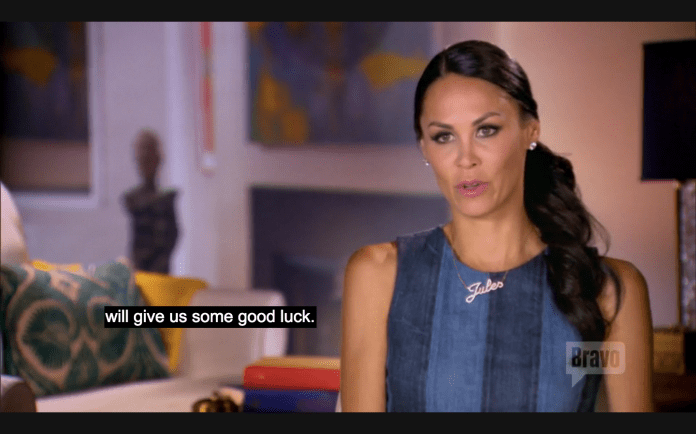
This finale was one of the darkest I’ve ever seen, from the glimpses of turbulent pain in Jules’ eyes as she says that she hopes hers and Michael’s eighth anniversary will be lucky for their marriage, knowing full well that in the time of the testimonial filming, her relationship has already headed for divorce. The blind faith of Dorinda. The magic eyes of Ramona. Sonja looked amazing, but she always does. The upcoming knowledge of what Carole will wear to the Reunion. All SUPER dark stuff, you guys.

And at the center of the tornado, in a circle of belying calm, are Bethenny and Luann. Their friendship in tatters, and Bethenny’s utter disbelief that Luann could attack her for Bethenny’s probably first, and last, attempt at benevolent, no-strings-attached do-gooding. Luann will choose her LuMan every time, and the rest of the girls are just collateral damage.

I typed this all on my new LAPTOP, so I haven’t quite got the hang of it yet, but I wanted to put up content. Also my BIRTHDAY IS TOMORROW #TWENTYFUN. Ugh I hate myself for that hashtag, but I won’t delete it. I need to learn from my shame.

Favorite Moments:

This slideshow requires JavaScript.

  • Bethenny screaming at a waiter to never serve vegetarian ceviche in her presence again.
  • Luann: “Me and Tom are doing our own therapy. People tell us to go to a therapist, I say, Why?”
  • Everyone loving Adam’s new haircut. It’s cute. It’s not that cute.
  • Sonja being confused by food and reminding us, yet again, that she and Tom were lovers and that her current boyfriend gets his rocks off to antique napkins.
Standard